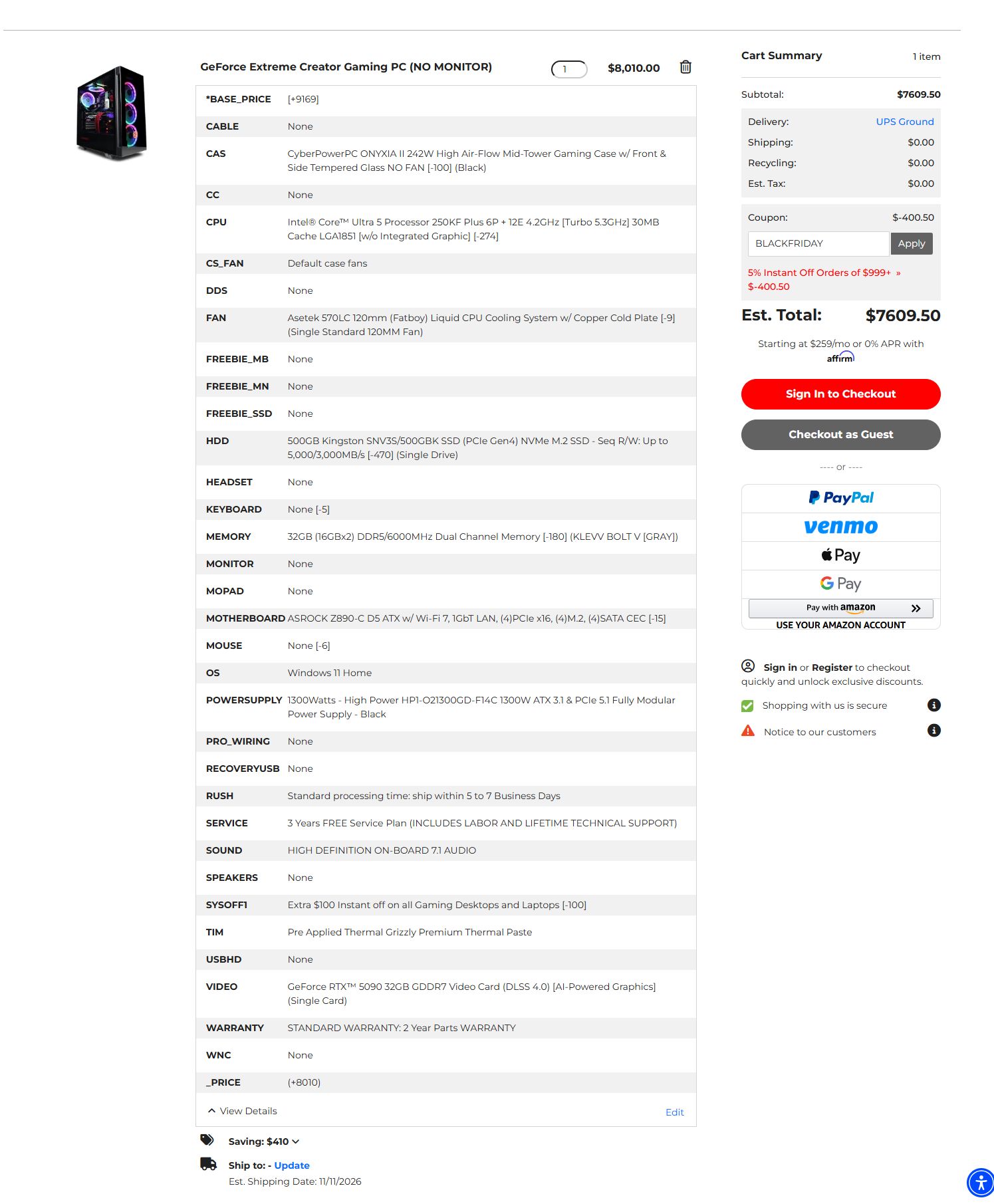
Graphics card pricing has climbed so far that a full RTX 5090 desktop can now cost less than the card by itself. CyberPowerPC is selling its GeForce Extreme Creator Gaming PC for $7,609.50 after a $400.50 promotional discount, while the same ASUS TUF Gaming GeForce RTX 5090 inside it carries a $7,679.80 price tag on Amazon. In practical terms, the rest of the computer arrives for less than nothing.
What the CyberPowerPC configuration includes
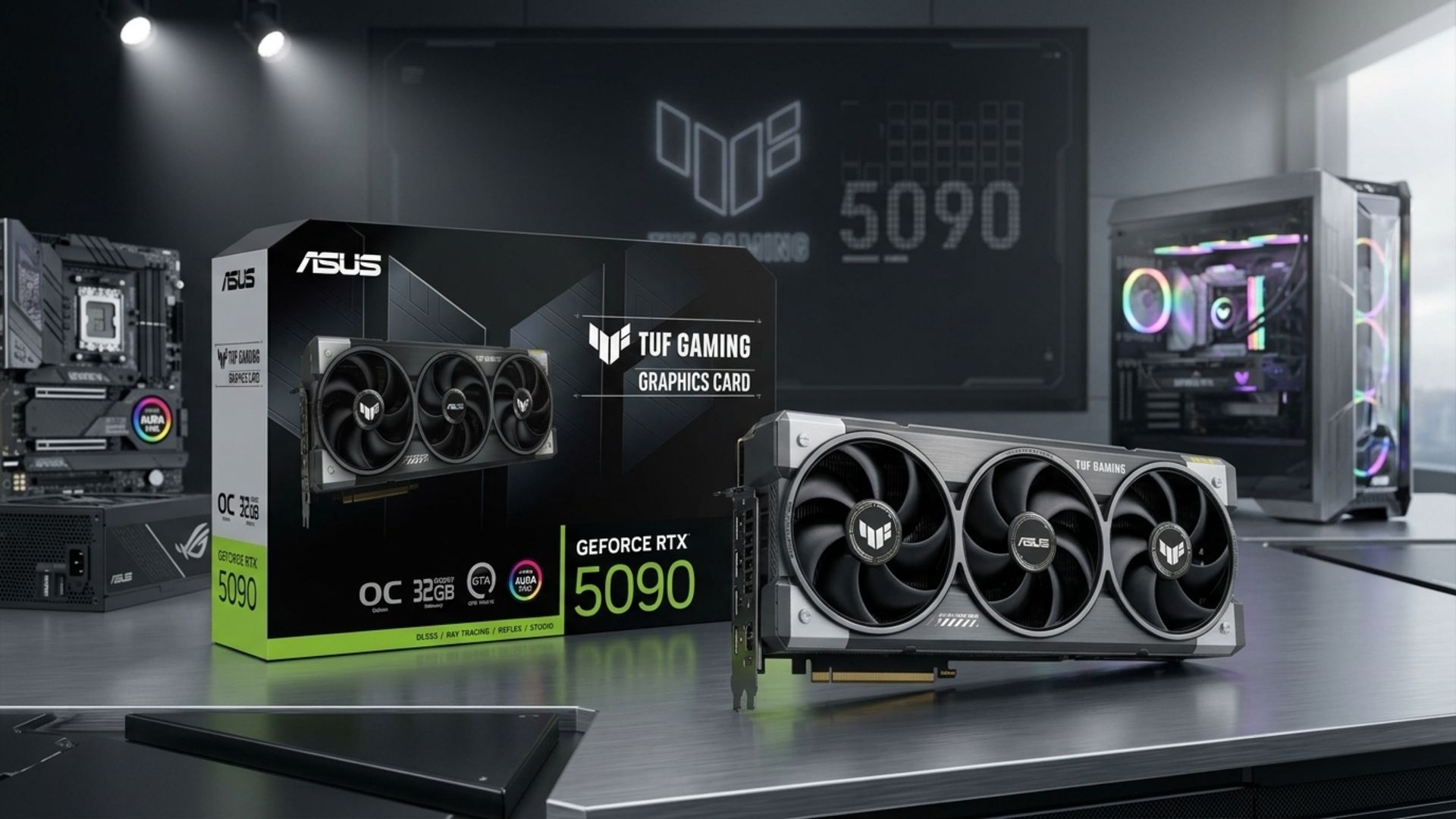
The centerpiece is ASUS’s TUF Gaming GeForce RTX 5090, equipped with 32GB of GDDR7 memory and built around PCIe 5.0, HDMI 2.1b and DisplayPort 2.1b connections. Its Axial-tech cooling handles heat from the flagship GPU.
Intel’s Core Ultra 5 250KF sits at the heart of the system, with six performance cores, twelve efficiency cores and a maximum turbo frequency of 5.3GHz. It is not Intel’s priciest desktop chip, but the specification offers a solid base for games and heavy computing tasks.
Supporting components include:
- A 1,300W fully modular power supply
- An Asetek 570LC liquid cooler for the processor
- 32GB of DDR5 memory running at 6,000MHz
- A 500GB Kingston NVMe SSD connected over PCIe Gen4
- An ASRock Z890-C D5 motherboard
- Wi-Fi 7 and Windows 11 Home
- A CyberPowerPC Onyxia II enclosure
CyberPowerPC backs the machine with a two-year parts warranty, labour coverage and lifetime technical assistance. The $7,609.50 price does not include a monitor, keyboard or mouse, so a buyer’s total outlay will rise once peripherals are added. The 500GB drive also leaves limited room for a large game library, and additional storage may become necessary later.
Why a laptop with the same name is not the same machine
Gaming laptops carrying RTX 5090 branding can be had for less money, but the mobile graphics processor inside them is a different class of hardware. Laptop makers must work within tight cooling limits, battery draw and chassis dimensions, which forces substantially different power configurations. The result is that a mobile RTX 5090 generally delivers considerably less graphics performance than the desktop card, even though both share the same product designation.
The desktop version’s 32GB of GDDR7 memory also gives it a clear advantage in demanding graphics work and local artificial intelligence applications. Price comparisons that ignore this hardware gap can therefore paint a misleading of what each buyer actually receives.
The value calculation in a scarce market
Standalone RTX 5090 cards are selling for several times their original launch prices as supply remains scarce. Against that backdrop, the CyberPowerPC system’s price is notable not because it is low in absolute terms — $7,609.50 is still a substantial sum — but because the graphics card accounts for essentially the entire cost. The processor, memory, storage, cooling, power supply, motherboard, case and warranty come along with it.
For anyone set on the flagship desktop GPU, the choice between buying the card alone and buying this complete system is less about finding a bargain than about which purchase makes more sense. One delivers a graphics card. The other delivers a working computer for roughly the same money.