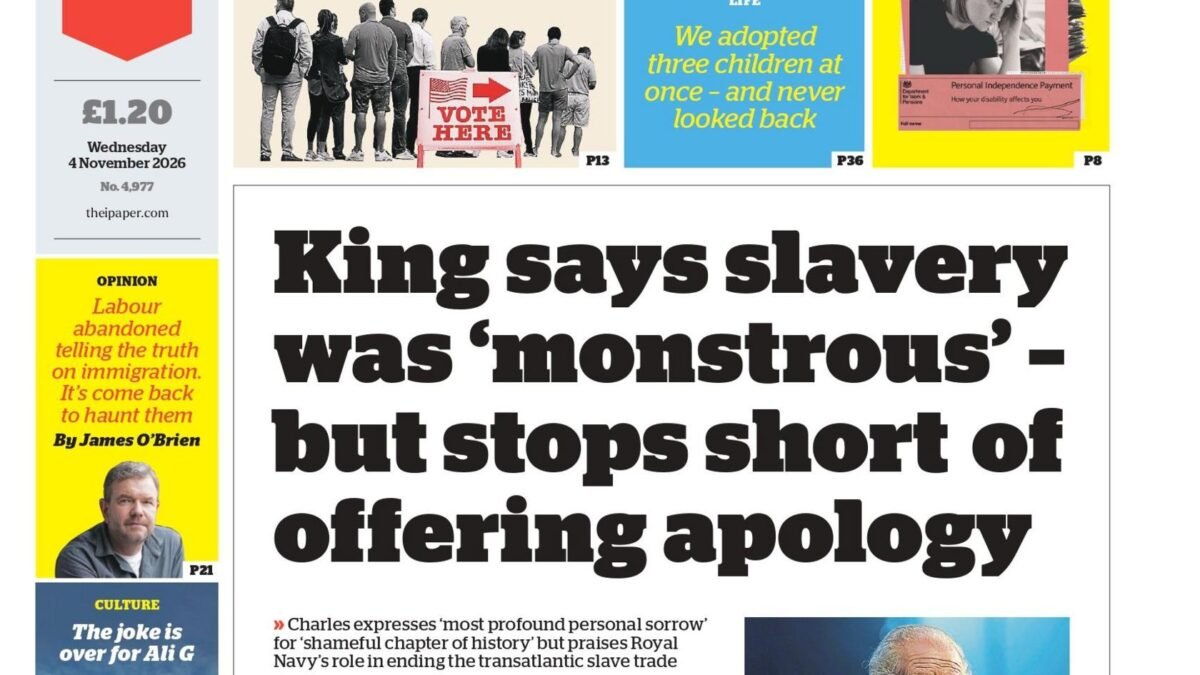
King Charles III used his address to Commonwealth leaders in Antigua and Barbuda to describe slavery as “monstrous,” according to front-page coverage in several UK newspapers. The King Charles slavery speech, however, did not include a formal apology, a point highlighted by the i Paper.
The i Paper reported that the monarch “stops short of apologising” while praising the Royal Navy for its part in bringing the transatlantic slave trade to an end. The Daily Mail characterised the address as “punchier-than-expected,” noting the King’s remark that “we cannot change the past” and his reminder of the Navy’s role in ending the trade.
The Times led with the King expressing “most profound sorrow” over the slave trade, describing it as a “shameful chapter of history” that filled his heart with horror. The paper’s summary of his message was that slavery was evil but that Britain helped end it.
Burnham’s Aid Offer and Reparations Debate

The Daily Express focused on Prime Minister Andy Burnham’s plan to say sorry for the slave trade, arguing it “will cost us.” The paper quoted critics who view Burnham’s £40m aid offer as a “lever to wedge open the door to ask for cash,” which it said could lead to “reparations by stealth.” Burnham has ruled out financial reparations.
Celebrity Loses High Court Gag Bid

Several papers reported that a well-known male celebrity lost his High Court bid to prevent sexual abuse allegations from being published. The Sun’s front page carried the headline “Sex Pest Loses Gag Bid,” with a pen scribble covering the space where the name would appear. The paper said the star is accused of inappropriate and exploitative sexual activities with multiple young women.
The Daily Star reported that the celebrity’s identity will remain “secret for now,” pending any appeal. The Daily Mirror said the judge ruled that allegations from a large number of women can be reported, noting the man faces claims he tried to engage in “exploitative sexual activities.” The Sun added that despite the defeat in the High Court, it still cannot name him because of a pending possible appeal.
Telegraph Campaign Against Trans Law

The Daily Telegraph led on its campaign to scrap what it called a “chilling” trans law. The paper suggested the Draft Conversation Practices Bill risks criminalising parents who question whether their children are trans. Writing in the Telegraph, Baroness Falkner, a former chair of the Equality and Human Rights Commission, described the law as an “unprecedented and unwarranted intrusion into family life.” The government said the draft bill will “outlaw a specific form of abuse” while setting high bars that protect regular parenting.
Other Front-Page Stories

The Guardian reported that Burnham plans to unveil an “EU youth visa pact and trade deals worth billions” ahead of a summit in Brussels on 20 November, covering issues from youth visas to pet passports. The same paper covered “flights hit by ‘malicious hoax’ bomb threats,” writing that seven passenger flights across Europe were searched or diverted.
The Metro splashed on comments from Richard Horne, head of the National Cyber Security Centre, who said Britain has “done tech on the cheap” for decades and warned that hostile states such as Russia and China will “routinely use AI” for crime by 2028.
The Financial Times reported that chipmaker Nvidia is demanding a cut in clients’ China dealings to protect America’s “AI lead,” citing anonymous sources. The paper said the instructions to data centre partners were communicated verbally and by Nvidia’s sales teams rather than spelled out in documents. The FT also reported that President Donald Trump awaits voters’ verdict in the midterm elections, with Republicans risking defeats in both chambers of Congress.
Elsewhere, the Financial Times said the Conservatives have turned to former Prime Minister Lord Cameron to “charm donors” and build on Kemi Badenoch’s revival. He was described as the “star attraction” for a Cities of London and Westminster Conservative association event next month, where tickets cost up to £345 a seat.
Finally, Kellogg’s announced that Rice Krispies will no longer be made with rice grains, switching to a mix of rice flour and corn flour. The Times asked whether they will “presumably” continue to be crispy.