
The long-feared collision between AI and white-collar jobs did not materialize in October’s employment data. Instead, the month delivered a clear signal that the labor market is reshaping what employers expect from professional workers, not eliminating the roles themselves.
Professional and business services — a category spanning legal work, consulting, and scientific research — added 70,000 positions in October. That figure dwarfed the sector’s recent monthly average of 15,000 over the past year and marked a sharp turnaround from the low it touched twelve months earlier.
A Rebound That Challenges the Automation Narrative
Heather Long, chief economist at Navy Federal Credit Union, pointed to the surge as evidence that fears of an AI-driven white-collar wipeout have been overstated. She also flagged a notable jump in administrative assistant hiring as an additional encouraging signal within the report.
The numbers suggest that rather than hollowing out professional work, AI is redrawing the boundaries of what those jobs involve. ZipRecruiter economist Nicole Bachaud said the technology is altering role requirements and the mix of skills in demand, which in turn creates instability in tech-heavy industries.
According to Bachaud, employers are increasingly seeking candidates with AI literacy or soft skills such as critical thinking, sometimes at the expense of conventional technical qualifications. That shift, she suggested, could produce more churn in professional and business services, financial activities, and information sectors in the months ahead.
Temporary Hiring and the Limits of One Report
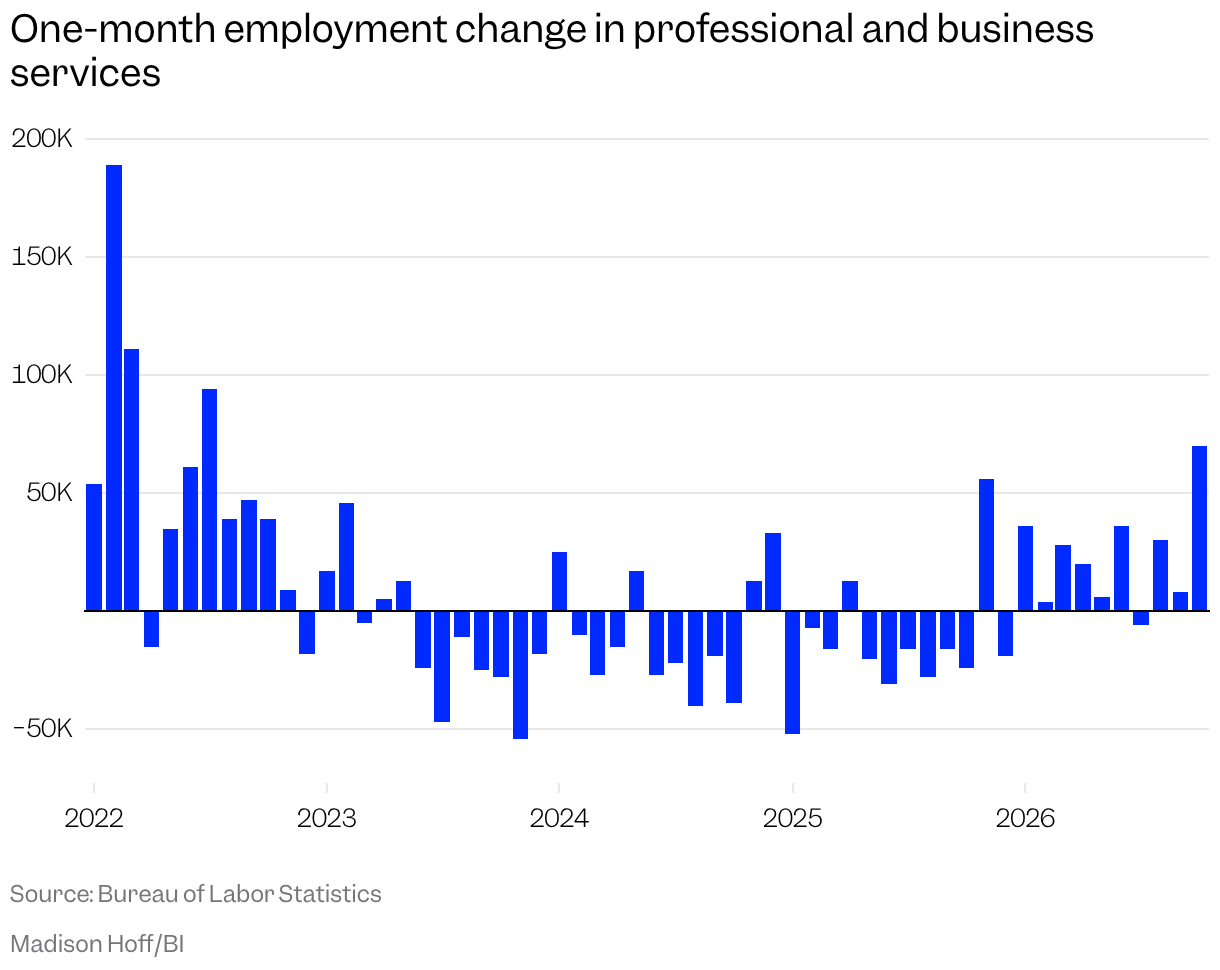
Part of October’s professional and business services gain came from temporary help services, which added 18,600 jobs after losing 5,600 in September. Bachaud interpreted that pattern as a sign that employers are beginning to make business commitments without yet bringing on full-time staff.
Cory Stahle, senior economist at Indeed, cautioned against reading too much into a single month. He noted that the sector remains below its long-term trend and that the recent growth may partly reflect a catch-up effect rather than a new normal. A noisy industry, he added, makes it premature to draw firm conclusions about AI’s impact on knowledge workers from one report.
Other Sectors Show Mixed Signals
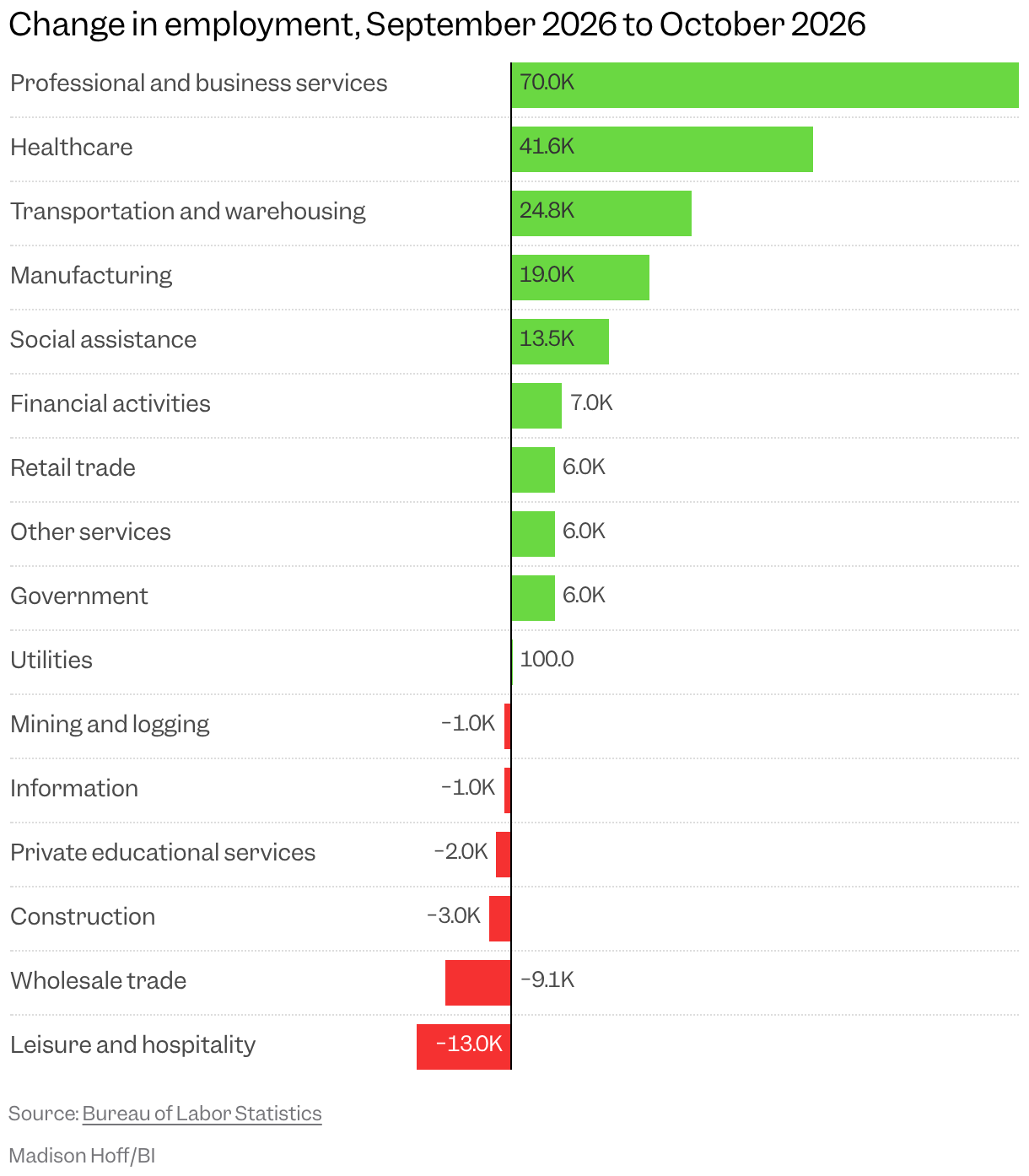
Healthcare continued its longstanding role as a job market anchor, adding roughly 42,000 positions. Manufacturing contributed 19,000 jobs. Transportation and warehousing posted a solid gain of about 25,000, with couriers and messengers accounting for 70% of that increase.
Bachaud said the transportation and warehousing uptick could indicate a holiday shopping season ramping up more than expected, despite concerns that high gas prices, inflation, and elevated interest rates might dampen consumer activity.
Construction, by contrast, shed jobs. Gains for electricians and specialty contractors working on data centers and other commercial and industrial projects were not enough to offset losses elsewhere in the sector — a reminder that even robust data center building has not been sufficient to prop up the broader construction industry.
What the Overall Suggests
The October report painted a brighter labor market than many anticipated, helped by upward revisions to the prior two months and better-than-expected growth alongside rising labor force participation. For Bachaud, the data points to workers who are ready to make moves, with pent-up demand beginning to unlock.
For white-collar workers, the takeaway is less about job losses than about adaptation. The demand is still there, but the qualifications are moving — and the next few months will reveal where that volatility settles.