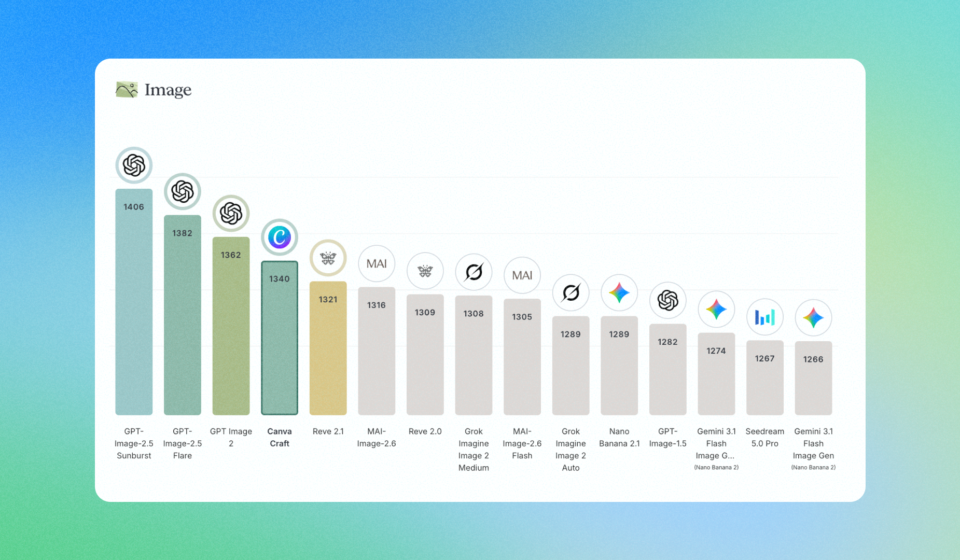

Canva Craft, the company’s first publicly available generation model, arrives with a distinct training pedigree and a respectable competitive debut. Rather than learning from flat collections, Craft was trained on millions of human-designed Canva templates. That choice gives the model something its rivals must infer: an understanding of layers, layout and how visual elements relate to one another on a canvas.
Composition Before Generation
According to Canva, Craft plans a composition before it produces an . The model decides where elements should sit, how a design should be structured and where text belongs. This approach is intended to serve marketing materials and social media graphics, where arrangement matters as much as the imagery itself.
Canva says the model also grasps visual hierarchy and typography. Those are the building blocks of design work, not just -making, and they reflect the template data behind Craft’s development.
Where Craft Lands on DesignArena
Craft debuted fourth overall on the DesignArena generation leaderboard. Three OpenAI models finished above it. Still, the placement puts Canva’s model ahead of several GPT, Grok and Gemini entries, and it outperformed Nano Banana 2.1.
The overall ranking only tells part of the story. Craft took first place among 87 models for people and portraits, and first among 85 models for landscapes and nature. It ranked second for abstract designs and patterns. Canva claims that Canva Research, its internal lab, is the second-highest performing AI lab for generation.
A Lab That Tripled in Size
The launch follows a year of expansion inside Canva Research. The lab tripled in size over the past year, an investment that precedes Craft’s public release. Canva’s decision to build in-house models rather than rely on third parties gives it more control over the economics of generative AI, according to the company. That consideration carries weight as agentic AI costing remains unpredictable for enterprise users.
API Access and What Comes Next
Craft is not confined to Canva’s own platform. Developers can reach the model through an API, allowing integration into other platforms. The model is not locked into the Canva ecosystem.
Canva plans future generations of Craft. The company promises that later versions will be faster and more affordable than the current release. For now, Craft’s template-based training and its strong showing in specific categories give Canva a foothold in a field dominated by OpenAI and Google.