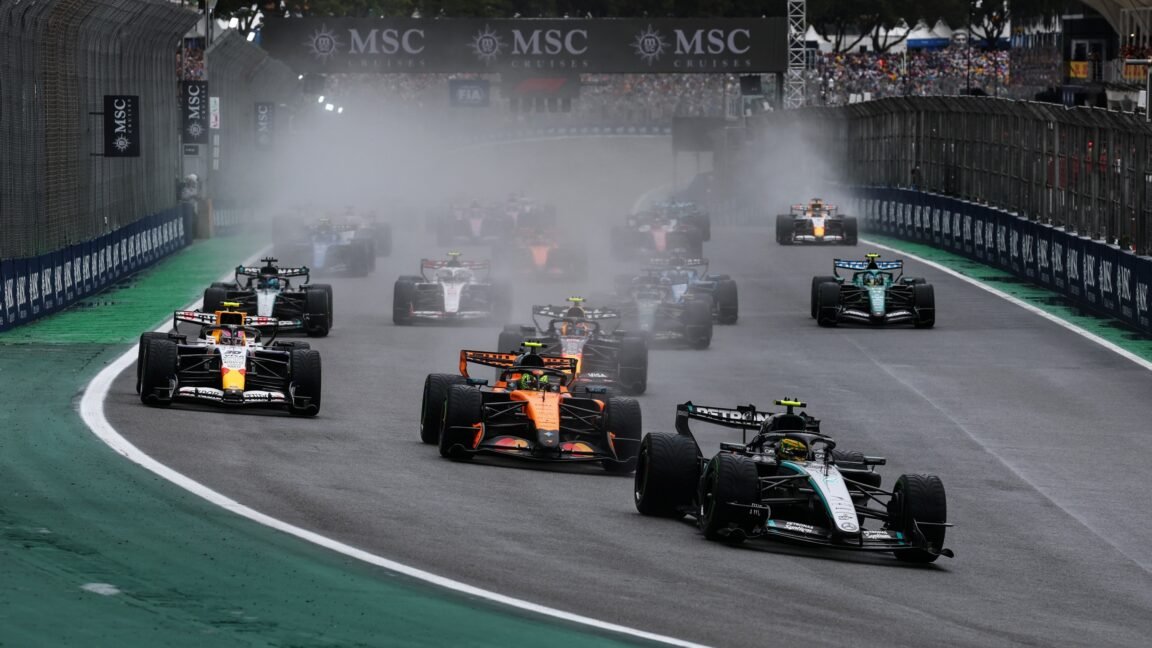
The phrase “dead rubber” usually signals a contest with nothing meaningful left to play for, and the Brazilian Grand Prix dead rubber had all the makings of a race easy to skip. The championship had already been decided, so the usual stakes were gone. Yet the weekend delivered one of the year’s most entertaining races, driven by a scrambled starting order, very quick drivers starting near the back, and a wet track that dried before rain returned.
Why the Brazilian Grand Prix still mattered
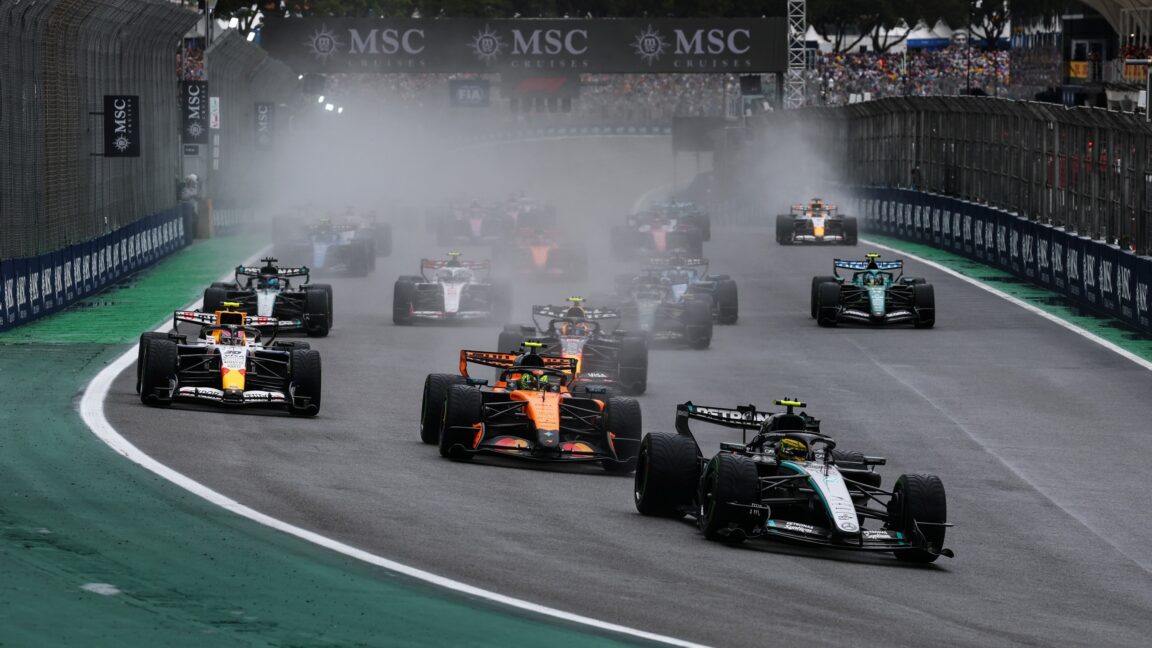
Series organizers dislike dead rubbers because viewers disappear once a title is wrapped up early. The Brazilian Grand Prix dead rubber fit that pattern on paper, but the on-track action told a different story. A mixed-up grid, combined with changing weather, created the kind of unpredictable race that keeps fans watching even when the championship is no longer in play.
That unpredictability began in qualifying. Rain on Saturday helped jumble the usual running order, and it was heavy enough that drivers used the wet weather tire with deep treads. Those tires usually generate so much spray that visibility disappears and running has to be suspended. In this case, the later knockout qualifying sessions had fewer cars on track, so the spray was not a problem for once.
Grid penalties add to the shuffle
More disruption came from grid penalties for Max Verstappen and Ferrari’s Lewis Hamilton, both of whom needed to use extra power unit components outside of the season’s allowance. Those penalties pushed two of the fastest drivers further back, setting up the possibility of charges through the field once the race began.
The result was a starting order that bore little resemblance to the normal competitive hierarchy. Fast cars starting out of position, combined with a track that changed from wet to dry and back again, gave the race a chaotic energy that a settled championship could not suppress.
Norris shows championship form
Among the storylines was Lando Norris, who took the 2025 crown after a nail-biting fight with his teammate Oscar Piastri and Red Bull’s Max Verstappen. A peculiarity of Formula 1 is that winning a championship does not guarantee a team will be in a position to defend it. McLaren did not start this year in a position to win races, and even with several upgrades, the team has produced a car that is still very tricky to drive.
But in Brazil, Norris demonstrated the form that earned him the number 1. His performance was a reminder that even when the title is settled, individual drivers and teams still have pride, momentum and future seasons to compete for. The Brazilian Grand Prix dead rubber became a stage for that kind of competition.
A race worth watching
Anyone who decided to skip the Brazilian Grand Prix missed a race that combined the elements fans hope for: a mixed-up starting order, fast drivers at the back, and weather that kept teams guessing. The championship may have been decided, but the race itself was anything but meaningless. The Brazilian Grand Prix dead rubber turned out to be one of the year’s most entertaining events, a reminder that in Formula 1, the on-track product can still deliver even when the points no longer decide a title.