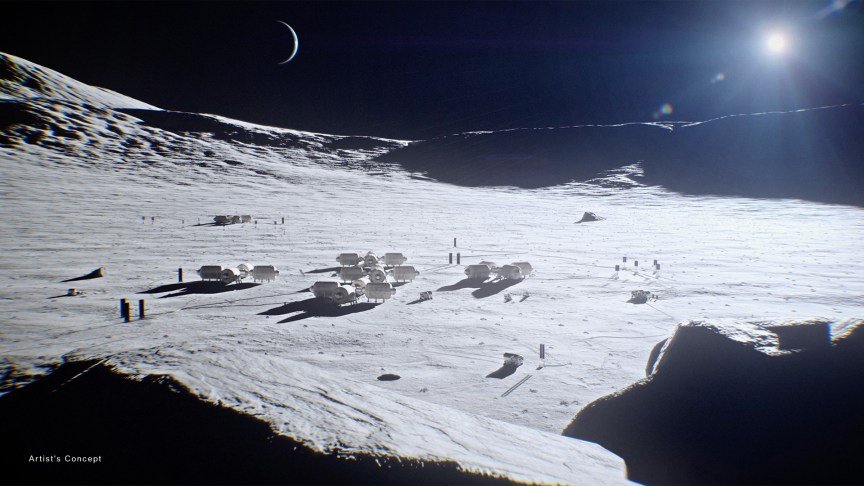
At its first aerospace technology expo, NASA laid out the hardware, funding and partnerships behind its NASA moon base plan, a campaign meant to establish a sustained human presence on the lunar surface by 2032. The Max Power event ran Wednesday through Sunday at the Kennedy Space Center in Florida and served as the stage for updates on the Ignition initiative, the agency’s umbrella effort for the base.
A mission-by-mission build

NASA administrator Jared Isaacman described the project as one assembled incrementally rather than delivered in a single launch. He told attendees that astronauts returning to the moon will find the first pieces of the base already waiting for them on the surface. The Artemis program, which is scheduled to fly its third mission in 2027 and return people to the moon in 2028, is being treated as a stepping stone toward the base. Because of that link, the loss of Blue Origin’s New Glenn rocket in a May explosion carried extra weight for the broader effort.
Commercial aerospace partners will carry much of the load. Blue Origin, Firefly Aerospace, Intuitive Machines, Lockheed Martin, Northrop Grumman, SpaceX, Voyager Technologies and ispace-US are among the companies NASA is leaning on, and most of them already supply technology for Artemis.
Cargo landers and a $10 billion contract

Keeping a steady flow of supplies moving to the lunar surface is central to the plan. NASA selected eight companies to handle that work under CLPS 2, the next phase of its Commercial Lunar Payload Services initiative. The contract is designed to develop the infrastructure and vehicles, including cargo landers, needed to ferry supplies and crew between Earth and the moon on a continuing basis. NASA set the CLPS 2 budget at $10 billion and expanded the earlier CLPS 1.0 budget from $2.6 billion to $4.2 billion.
The goal is to pre-position materials and equipment so that astronauts can begin construction soon after landing rather than waiting for later deliveries.
Freight trucks in orbit

Cargo landers still have to reach the moon, and NASA is funding a separate class of vehicles to get them there. The agency announced $1.3 billion for Blue Origin, Arrow Science and Technology and Impulse Space to build Orbital Transfer Vehicles, which function as long-distance freight haulers for cargo landers before deployment to the surface.
Three missions are planned around that hardware. One will study how to reduce human risk and identify the best methods for deploying CLPS landers. Another will use NASA’s MoonFall drones to survey the moon and locate the most suitable site for a base. The third will test the infrastructure to confirm it performs as intended.
Promise, the nuclear-powered rover

Surface exploration will depend heavily on Promise, short for Polar Rover for Observation, Mapping and In-Situ Exploration. Blue Origin received a $94 million development contract for the vehicle, along with a performance-based $140 million for lunar delivery. NASA’s Jet Propulsion Laboratory at Caltech will manage the rover once it is deployed, the same laboratory that oversees the agency’s other rovers, the Deep Space Network and the Voyager probes.
Promise’s nuclear core sets it apart from solar-powered rovers. It can keep working through the two-week lunar night and inside permanently shadowed regions that never see sunlight. Its tasks include analyzing regolith, searching for ice and carrying out general exploration.
Power and infrastructure on the surface

The final portion of the announcements addressed long-term habitability, the systems astronauts will need to live and work on the moon. NASA awarded contracts for energy storage and transmission to Honeybee Robotics, a Blue Origin company, and Yank Technologies. Their solar arrays, batteries and wireless power hardware will come together in the Mini-Communications and Solar Tower, or miniCast, which will be assembled at NASA’s Marshall Space Flight Center in Huntsville, Alabama, before shipment to the moon.
A student challenge with $1 million in prizes
NASA also opened the Moon Base Student Challenge, inviting students to propose solutions to the many problems standing between the agency and a permanent lunar presence. Winners will share $1 million in prizes. Isaacman framed the effort as an open call, telling an audience that included many students and children that they are being asked to help solve the obstacles to a lasting foothold on another world. The challenge does not target a single problem; participants can address any issue related to building a lunar base. NASA has turned to students before for help with questions such as lunar dust clouds and human-capable landers.