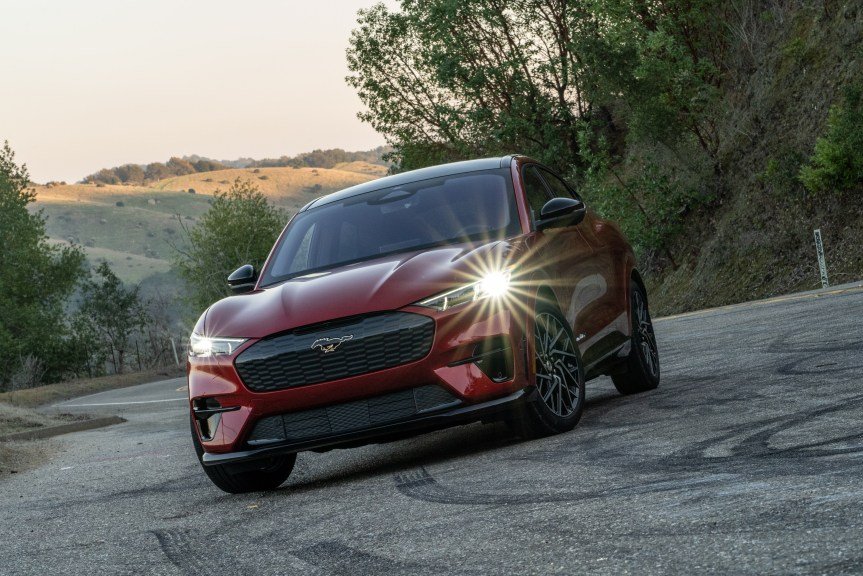
Ford has released fleet data on the Mach-E battery health after five years of customer use, and the numbers suggest that electric vehicle batteries do not collapse as quickly as some shoppers fear. The automaker examined more than 36,000 Mustang Mach-E SUVs from the 2021 model year sold across the United States and Canada. After more than five years on the road and an estimated 2 billion cumulative miles, the group averaged 92% battery health.
The finding matters most for the used EV market. A battery is the single most expensive part of an electric car, and shoppers weighing a pre-owned Mach-E often worry about losing range or facing a costly replacement. Ford’s report offers a large-scale data point suggesting that those fears may be overstated for its first-year fleet.
What the Numbers Show

Ford surveyed vehicles delivered in all 50 states and Canada during the Mach-E’s first year of sales. Roughly 95% of the surveyed vehicles retained between 87% and 97% of their battery health, with the fleet average landing at 92%. Because a healthier battery holds more usable range, the study implies that most owners are still getting close to the range their SUVs were rated for when new.
The 2021 Mach-E carried an EPA-estimated range of 211 to 305 miles depending on configuration. At 92% average health, that works out to a loss of roughly 16 to 24 miles of range over five years, based on simple arithmetic.
Higher mileage does bring more wear, but the decline appears gradual. About 2,000 vehicles in the group passed 100,000 miles and still averaged around 91% health. A much smaller set of roughly 30 drivers reached 200,000 miles, with an average of 88%. One owner reportedly exceeded 400,000 miles on the original battery, though Ford did not disclose that vehicle’s specific health reading.
Independent Data Points in the Same Direction

Ford’s figures are not an isolated outlier. Earlier this year, Austrian battery diagnostics firm Aviloo published an analysis of more than 500,000 EVs from 20 global brands, measuring degradation at 50,000, 100,000 and 150,000 kilometers. Several popular models stayed above 90% health at the higher mileage marks.
Among direct competitors, Aviloo found the Tesla Model Y at about 90.3% health at 150,000 kilometers (roughly 93,205 miles). The Volkswagen ID4 and Hyundai Ioniq 5 retained 90.6% and 92.8%, respectively, over the same distance. The first-generation Nissan Leaf, an older design with a smaller battery, showed more degradation at 86.3%, a tougher outcome given its shorter original range.
Why Five-Year Data Matters for Used EV Shoppers

Battery longevity has become a practical concern as more off-lease and pre-owned electric vehicles reach the market. Many analysts have pointed to used EVs as a way to avoid the price premium of a new electric car, but buyers may hesitate over higher-mileage examples. Ford’s study gives those shoppers a benchmark: a five-year-old Mach-E with average use is likely to retain most of its original battery capacity.
The report also fits with what Ford says about its design targets. Company engineers and battery chemists designed the Mach-E’s battery to last at least 10 years. The 2021 models in the study use an older nickel-cobalt-manganese, or NCM, chemistry.
A New Chemistry Coming

Ford’s next-generation Universal Electric Vehicle platform, which will underpin the upcoming Fathom small electric pickup, will use lithium iron phosphate chemistry instead. That change brings different charging needs and battery management calibration compared with the 2021 fleet. The UEV architecture is also built around bidirectional charging, which allows the vehicle to power a home. How that added duty cycle affects long-term battery health will not be clear until those vehicles have been on the road for several years.
For now, the Mach-E data adds weight to a growing body of evidence that EV batteries age slowly under real-world conditions. That is welcome news for anyone considering a used electric SUV, and a useful counterpoint to the assumption that high mileage automatically means a spent battery.