
At its London Experience Centre, Zoom outlined a strategy centred on the Zoom Unified Context Layer, a framework designed to make artificial intelligence a seamless part of everyday work rather than an added complication. The company’s ambition is to shift from being a meeting and chat platform to an assistant that understands the conversations flowing through its tools and helps users complete tasks without changing how they naturally operate.
Refusing to compromise on how work gets done

Louise Newbury-Smith, Zoom’s Head of UKI, described a long-standing pattern in which organisations adopted a platform and then had to bend their own processes around it. That is now changing, she said, as organisations begin to refuse to compromise and expect technology to adapt to their preferred ways of working. Zoom wants to reverse the old dynamic rather than reinforce it.
The company’s November 2025 launch of a UK data centre was presented as a key step for the region. Local data residency options now allow organisations such as local councils, NHS trusts and financial services firms to keep their data in the country. Newbury-Smith also stressed that EMEA is not a secondary market for Zoom but a high-growth opportunity, a view echoed by Nick Tidd, Head of Global Channel GTM, who pointed to the breadth of the product portfolio as a significant opening for customers and partners alike.
A context layer built on high-quality inputs
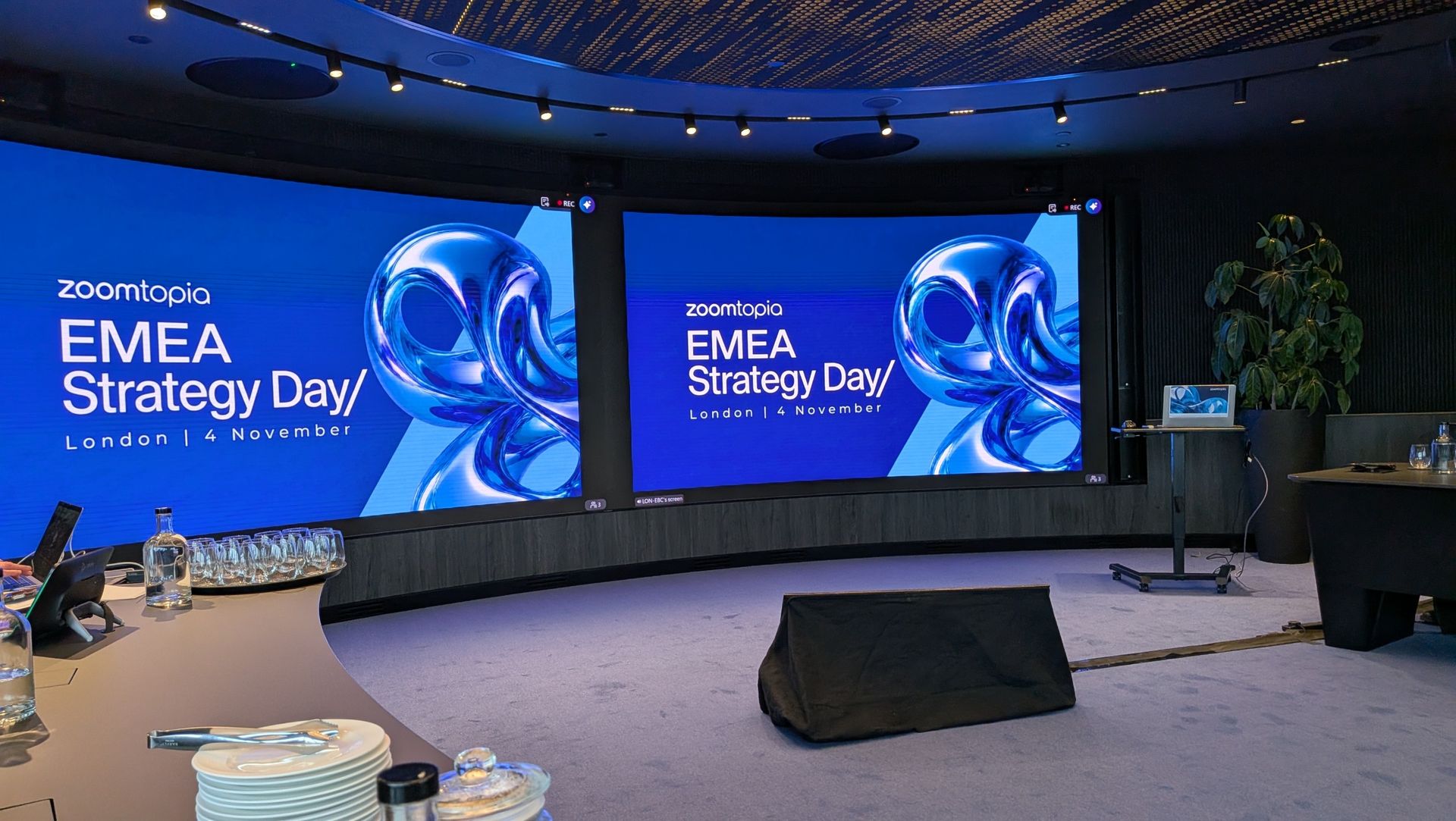
Leo Boulton, Head of Product, Solution and Industry Marketing, explained that Zoom’s concept of conversation to completion depends on context. Conversations are a natural part of how people work, he noted, so getting work done should feel equally natural and should not require a change in behaviour. When that naturalness is missing, workers tend to resist change, particularly where AI is concerned. Zoom’s answer is to embed intelligence directly into the work itself.
For AI to be genuinely useful, Boulton argued, it needs the highest-quality raw materials. That means conversations must be crisp, clear and understood, with genuine eye contact. Zoom has been improving audio and video fidelity accordingly. Two upcoming tools illustrate the point: a real-time voice smoothing feature called touch up my voice, and a pose correction tool that helps create greater eye-to-eye contact during calls. Better inputs, in Zoom’s view, lead to better AI output.
The same principle applies to agents and assistants. Boulton demonstrated a live assist feature that will offer proactive suggestions during a call, such as advising a user to speak more slowly or more quickly. The better an agent understands the business, the more effectively it can support the person on the other end.
An open layer that meets people where they work
Zoom Chat is also receiving a significant upgrade, positioned as a shared space where people and agents interact and collaborate. Boulton made clear that Zoom does not expect customers to live entirely inside its platform. True adoption, he said, happens when tools feel natural, which is why the context layer is open by design. The aim is to bring intelligence into whatever interface people already choose to work in.
That open approach is central to how Zoom differentiates itself. Tidd argued that the company’s position across the product portfolio allows it to capture conversations and place them into context within the workflow, a capability he described as distinct from others in the market.
Newbury-Smith summed up the direction as building and serving customers where they are. For Zoom, the next phase is less about adding more features and more about making the intelligence behind those features feel like a natural extension of the way people already communicate and get work done.