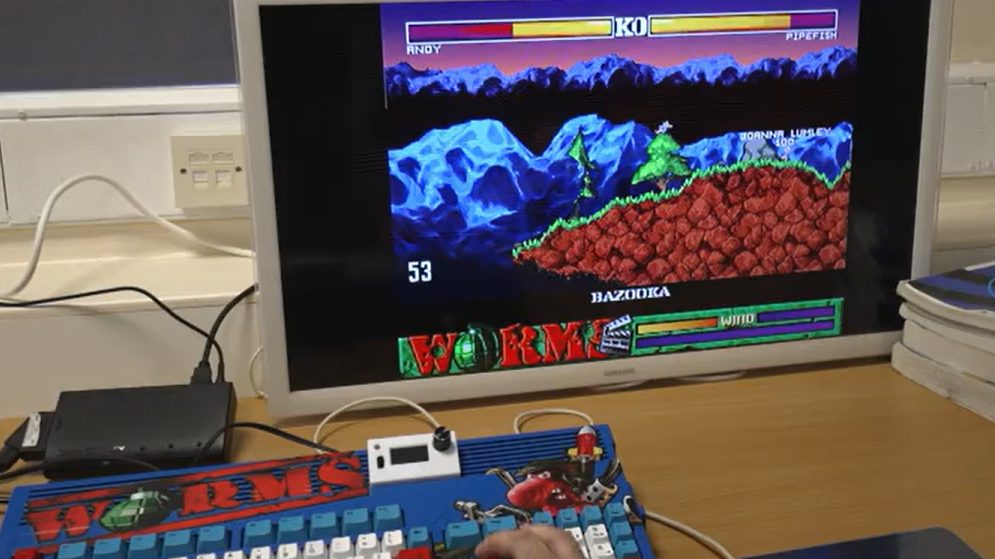
The Worms game, one of Britain’s most enduring video game exports, began not in a professional studio but in the classrooms and corridors of Bournemouth School. Andy Davidson was 22 when the game he had programmed, partly during his final years at the school, first reached shop shelves. Thirty-one years later, the series has sold enough copies for every person in the UK to own one.
Davidson puts the figure at up to 70 million across all formats and versions. “I just can’t get my head around it,” he said.
From calculator challenge to classroom club

The game’s origins were far humbler than its eventual reach. Bored during his A-levels, Davidson set himself and a friend a challenge: build a game on a Casio graph-plotting calculator. He found A-levels difficult, maths especially, but discovered that the device could run a simple program if pushed hard enough. The result was a small tank game, and from there the idea gathered momentum.
At the time, Davidson’s art teacher John Pakeman was becoming curious about what machines like the Amiga could do for art. Once he saw the computer’s capabilities, he decided he ought to get one. Interest among other sixth formers at the school was so strong that a club formed almost inevitably.
It was partly within Pakeman’s Amiga club that the project, initially called Total Wormage, began to take shape. The game was eventually banned from school as pupils crowded around the corner of the art room to watch it. For Davidson, that was a signal he might be onto something.
Pakeman, despite being present at the time, was unsure whether his student would find a company willing to take the game on. He later gathered that Davidson did exactly that. Pakeman himself has never played Worms, though he has seen screenshots and knows friends who have played. When the game comes up in conversation, he said, those friends start beaming, and his research tells him it is quite addictive.
A deal with Team 17 and a place on a stamp

Davidson signed with the West Yorkshire-based company Team 17 to release Worms in November 1995. The game is a turn-based artillery title in which players command a team of invertebrates and use creative methods to destroy opponents, with options including dynamite, a homing missile and an exploding sheep.
Davidson chose worms because they had not appeared in a game before. Their simple forms, he reasoned, would allow plenty of character in the animations.
The series’ legacy has since been recognised beyond the games industry. In January 2020, Worms was one of six British games celebrated on a special series of Royal Mail stamps. For Davidson, that moment brought the achievement home to his mother, who told everybody she could that the game had appeared on a stamp.
His teenage voice also survives in many people’s mobile phones. Davidson recorded the voices of all the angry worms, and he believes “Incoming” is the most famous because people use it as a text message alert. To him, the scale of it remains absurd: in his mind, it is still the little game he made for himself and his friends.