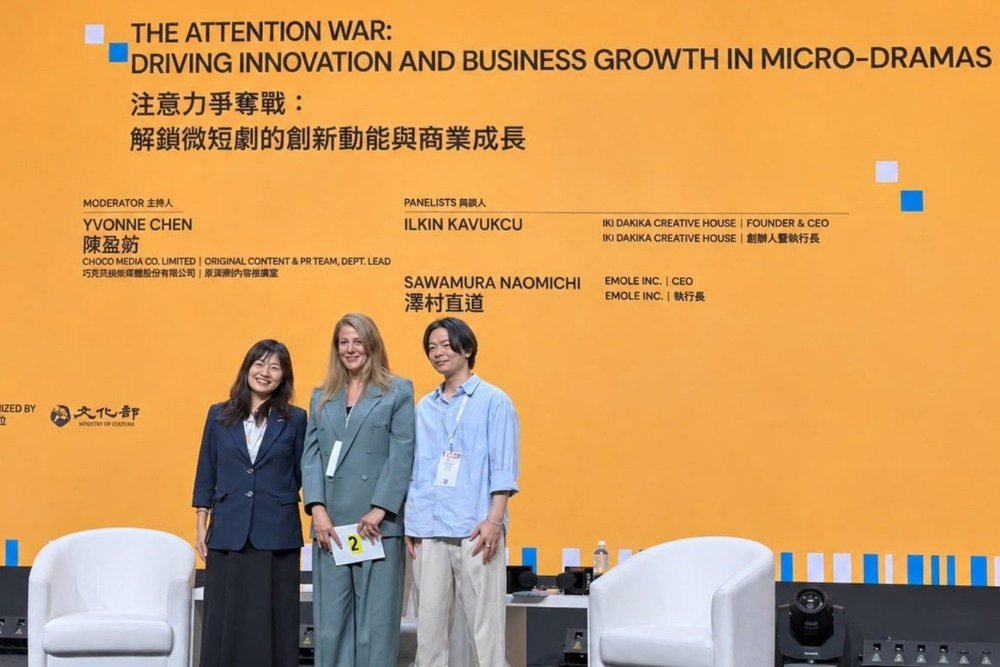
Microdrama makers at TCCF in Taipei offered a counterintuitive lesson for a format built on split-second attention: the strongest opening does not have to be a twist. İlkin Kavukcu, founder and CEO of Turkish studio İki Dakika Creative House, told a Taiwan Creative Content Fest session that her company searches for moments of emotional recognition — the kind that make a viewer pause mid-scroll and feel that a story has borrowed something from their own life.
That approach places character and shared feeling ahead of shock. Kavukcu described audience sharing as one signal that a series has truly connected, a measure that goes beyond a single viral beat.
Short episodes, longer character lives

İki Dakika distributes its microdramas on TikTok, Instagram and YouTube. Rather than stacking one-off plot turns, the studio aims to build longer-running stories around characters, according to Kavukcu. The strategy fits a format where episodes are brief but the audience’s relationship with a character can extend across many installments.
The session, held during the Taiwan Creative Content Fest, brought microdrama producers from Turkey and Japan together to discuss what makes the format work in crowded mobile feeds. The conversation centered on the craft of holding attention: emotional hooks that feel familiar, and villains whose behavior is designed to provoke a strong reaction.
Why an infuriating villain can keep viewers watching

The panel’s framing paired emotional hooks with infuriating villains, suggesting that microdramas often succeed by making viewers care — or seethe — quickly. A character who triggers frustration can function as a narrative engine, giving audiences a reason to keep returning to a story that unfolds in short bursts.
For İki Dakika, however, the emotional target is not only outrage. Kavukcu emphasized recognition: the moment a viewer sees something of their own life reflected in a scene. That connection, she suggested, is what turns a passive scroll into a shared viewing experience.
What the TCCF discussion signals for microdrama strategy
The Taiwan Creative Content Fest session placed microdramas alongside other content markets and festival conversations, reflecting the format’s growing presence in the broader entertainment industry. The discussion did not treat microdramas as a passing mobile novelty but as a storytelling form with its own tactics for retention and audience growth.
Kavukcu’s comments point to a practical test for producers: whether viewers pass a series along. Sharing becomes both a distribution mechanism and a creative benchmark. In a feed where countless series compete for the same seconds, a story that feels personally relevant may travel further than one that relies on a single dramatic reveal.
The panel also underscored the international exchange at the heart of the festival, with Turkish and Japanese makers comparing notes on a format that crosses borders through social platforms. Their shared focus was not on bigger twists but on sharper emotional triggers — recognition, frustration and the impulse to send a story to someone else.