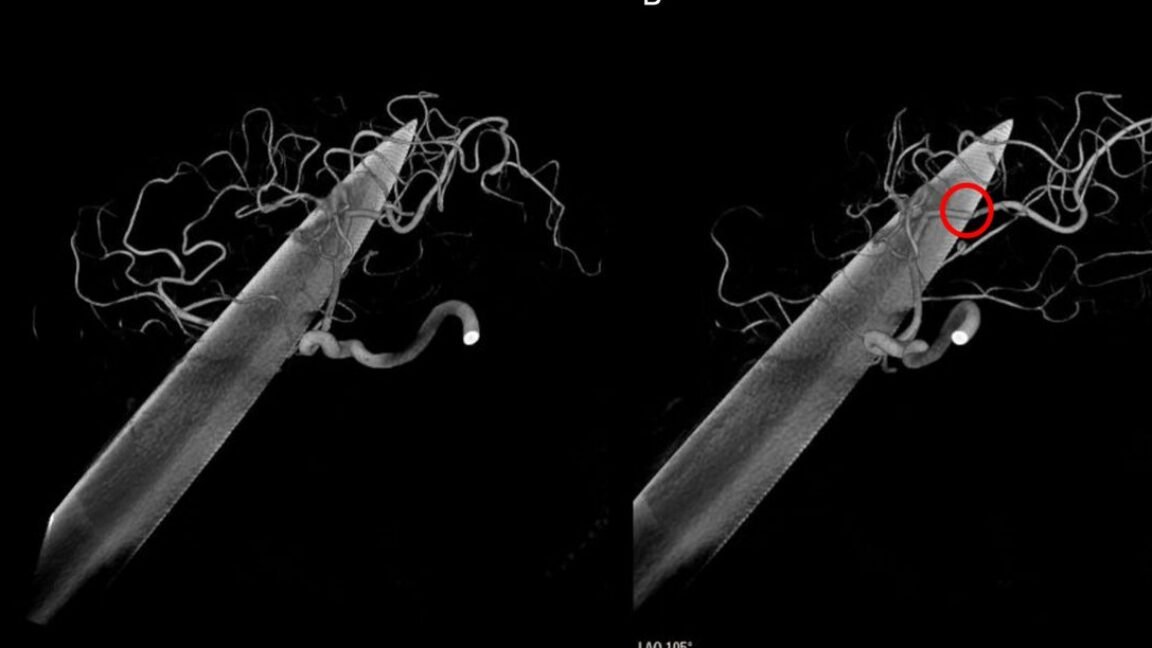
A man in his 20s walked into a UK hospital with the handle of a knife protruding from his face. The blade, about 15 mm wide, had passed through his right eye and brain, with its tip stopping at the top of his skull. Despite the severity of the knife through eye and brain injury, he was alive and conscious when he arrived, able to speak and move all four limbs. Doctors described him as agitated, and his Glasgow Coma Scale score of 12—E3 V4 M5—placed him in the moderate brain injury range, just one point above mild.
The case was detailed in a report published Friday in BMJ Case Reports. The medical team faced an immediate concern: in his confused and agitated state, the man might try to remove the knife himself. To prevent that, they quickly sedated and intubated him. They also started prophylactic treatments for bacterial infections, including tetanus, before using imaging to assess the damage inside his head.
Assessing the Neurological State
The Glasgow Coma Scale breakdown offered a precise snapshot of his condition. For eye opening (E3), he opened his left eye when instructed but otherwise kept it closed. For verbal response (V4), he could talk and answer questions, though he was confused. For motor response (M5), he intentionally moved away when pressure was applied to his body. These scores together indicated a moderate brain injury, a notable finding given the path the blade had taken.
The fact that the man could still talk and move all four limbs on arrival underscored the unpredictable nature of penetrating head injuries. The blade had traversed his right eye and brain, yet he remained conscious and communicative—a detail that likely shaped the doctors’ urgent approach to stabilizing him without further harm.
Immediate Clinical Priorities
Sedation and intubation served two purposes: protecting the patient from his own agitation and securing his airway for further evaluation. The prophylactic antibiotic regimen, which included tetanus coverage, aimed to ward off infection—a critical concern when a foreign object has breached the brain and eye. Only after these steps did the team turn to imaging to map the internal damage.
The report did not specify the imaging findings or the surgical steps that followed, but it confirmed that the man ultimately recovered. His outcome stands out against the grim expectations that often accompany such severe trauma.
What the Case Highlights
For clinicians, the case illustrates the importance of rapid sedation in agitated patients with penetrating injuries, especially when a foreign object remains in place. It also reinforces the need for immediate infection control and a structured neurological assessment using tools like the Glasgow Coma Scale. The man’s survival and recovery, despite a knife passing through his eye and brain, add a remarkable data point to the literature on severe head trauma.