
Japan’s Nikkei 225 dropped 6.2% to 57,271.19 in Friday morning trading, leading a broad retreat across Asia as the AI stock rout hits Asia following a sharp Wall Street sell-off tied to artificial intelligence companies.
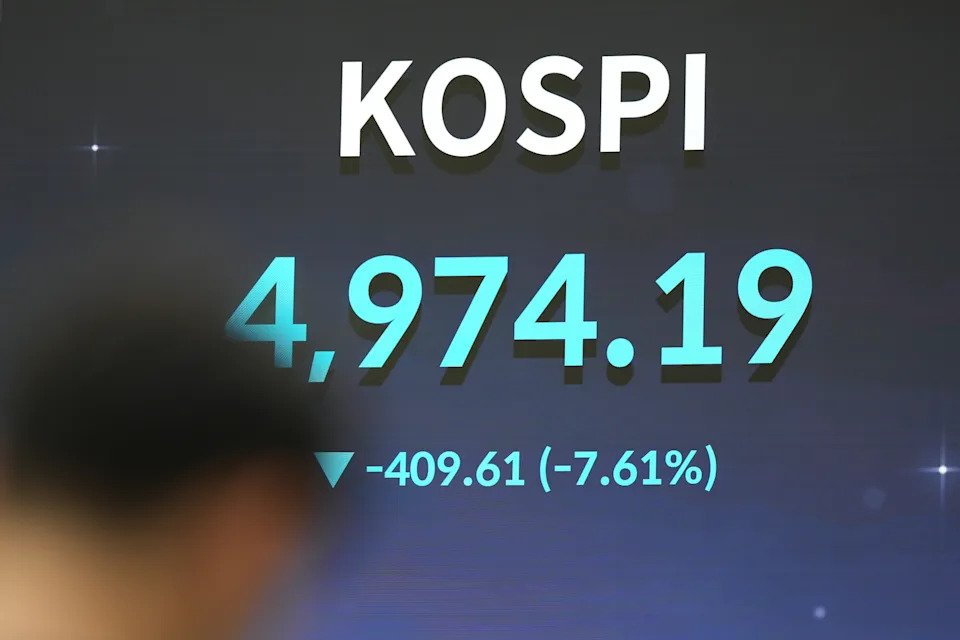
South Korea’s Kospi sank 7.1% to 5,000.25, while Australia’s S&P/ASX 200 slipped 0.7% to 9,003.40. The declines extended losses that began in the U.S. on Thursday, when the S&P 500 fell 4.4% for its worst session since April 2025, when President Donald Trump’s “Liberation Day” tariffs rattled global markets.
Wall Street's AI-Led Plunge Sets the Tone

The S&P 500 lost 334.89 points to close at 7,353.73, more than erasing its gain from the previous day, which had been its best in three months. The Dow Jones Industrial Average fell 1,833.06 points, or 3.4%, to 51,523.06, and the Nasdaq composite dropped 1,421.52 points, or 5.5%, to 24,315.00.
The Nasdaq, heavily weighted with AI-related and technology stocks, is now 11.9% below its all-time high set last month — a decline that market participants refer to as a correction.
AI-linked shares have been volatile for months amid concerns that construction of AI data centers could slow as borrowing costs rise. Critics also argue that AI stock valuations had climbed too high and were in bubble territory.
Nvidia and Chip Stocks Bear the Brunt

Nvidia, the chipmaker that became the emblem of the AI boom, fell 9.3% and was the heaviest single weight on the S&P 500. The stock is now down 2.6% for the year, following annual gains of roughly 39%, 171% and 239% over the past three years.
Advanced Micro Devices tumbled 17.3%, CoreWeave — which rents cloud access to AI chips — fell 9.8%, and GE Vernova, a company involved in powering data centers, sank 7.5%.
The pain is amplified by the sheer size of AI chip companies. A 1% move in Nvidia, for example, has a larger effect on the S&P 500 than a 1% move in nearly any other U.S. stock.
Election Results Add Another Layer of Uncertainty

Tuesday’s U.S. midterm elections introduced a fresh challenge for investors. Nationwide victories for Democrats raised the possibility that governments could push for pauses in data center construction. Voters across party lines have expressed unease about AI and dissatisfaction with higher electricity bills attributed to data centers.
Any slowdown in AI data center construction would translate into fewer purchases of AI chips, as well as reduced demand for electricity and other goods and services that have been swept up in the AI frenzy — a frenzy that has been driving much of U.S. economic growth.
Bonds and Energy

Treasury yields continued to fall Thursday, with the 10-year yield dropping to 4.84% from 4.90% late Wednesday. It had stood at 4.95% on election night and above 5.30% last month. The decline suggests investors are seeking the relative safety of U.S. government bonds as stocks tumble, even as some U.S. economic reports were encouraging, including fewer unemployment benefit applications last week.
In energy trading, U.S. crude added 0.60% to $91.06 a barrel, while Brent crude, the international benchmark, gained 3.88% to $98.29 a barrel. Uncertainty remains about the war with Iran and when the global energy industry might return to normal.
In currency markets, the U.S. dollar rose to 157.83 Japanese yen from 157.65 yen, and the euro cost $1.1216, down from $1.1218.
