
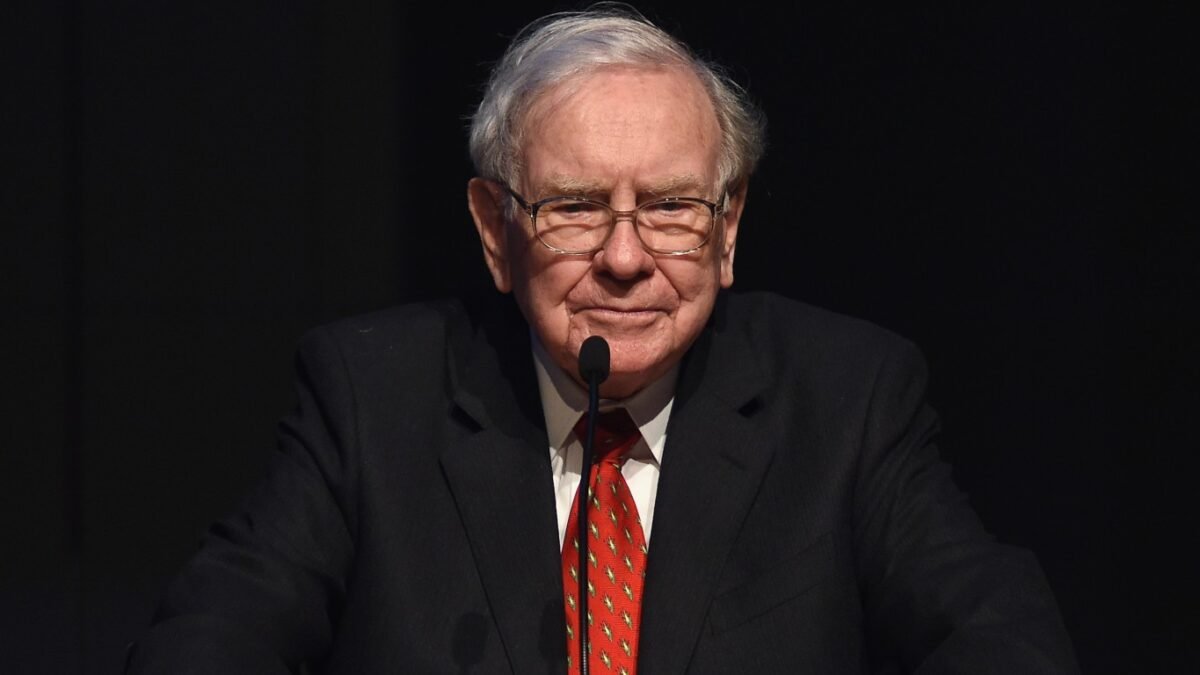
Warren Buffett’s 2008 rule was written for a Monday like this one. The Dow Jones Industrial Average climbed roughly 1,100 points, and the S&P 500 index fund gained 2.4% — its best session since April 8 — even though the worries that had driven the prior week’s selling remained unresolved. Buffett’s line, published in The New York Times on Oct. 17, 2008, put it plainly: waiting for the robins means spring will already be over.
The rebound arrived while the headlines were still bad. That is the point. Buffett wrote that the market would likely move higher, perhaps substantially, before either sentiment or the economy improved. Monday fit that description. The main change over the weekend was a drop in oil prices, not a resolution of the fears that had pushed stocks to their worst week since the tariff week of April 2025.
A retired couple's near-miss
Consider a couple, 66 and 63, with $1.8 million: $1.25 million in a rollover IRA, $400,000 in a brokerage account and $150,000 in a Roth. They hold 65% in an S&P 500 index fund — $1,170,000 at Friday’s close — and $630,000 in bonds and a money market fund. Social Security pays them $57,600 a year; they spend $118,000, so they draw $60,400 from the portfolio, or 3.4%.
On Friday afternoon, after a week of headlines, the husband typed an order to move $600,000 of the IRA’s index fund into the money market fund until things settled down. He did not send it. Had he done so, the $600,000 would have missed $14,158 of Monday’s gain. That is the visible cost of one day.
The larger cost is the signal problem. Selling until things settle down requires a sign that they have settled, and the usual sign is the index back at its record. The S&P 500 fund’s record sits 6.0% above Friday’s close. Waiting for that signal would mean buying back $566,268 worth of Friday’s shares — $33,732 less. In exchange, the money market fund would pay about 4.17%, the 3-month Treasury bill rate: $25,020 a year, or $2,085 a month.
What Buffett's rule cost first

Buffett was explicit that he could not predict short-term market moves. He was right to be careful. After his piece ran, with the S&P 500 fund at $93.21, it kept falling for five months, to $68.11 on March 9, 2009 — a 26.9% loss for anyone who bought that week. The robins came late. The recession ended in June 2009, but the National Bureau of Economic Research did not announce it until Sept. 20, 2010. By that day the fund had risen 67.7% from its low. One year after publication it was up 17.8%; five years after, 85.8%. Today it is 8.07 times its price on the day the piece ran, price only, dividends excluded: $100,000 held throughout is $807,467, against $129,634 in 3-month Treasury bills.
Why the best days cluster near the worst
The rule’s logic shows up in the daily closes of the S&P 500 fund since 2000. Of its 20 best days, 12 came within 10 trading days of one of its 20 worst. The two biggest — Oct. 13, 2008, up 14.5%, and Oct. 28, 2008, up 11.7% — landed in the middle of the crisis. The third biggest, April 9, 2025, up 10.5%, came three trading days after the tariff drop that still marks the last week worse than the one just ended.
That clustering is what a sell-and-wait order buys. $100,000 invested in the fund on Jan. 3, 2000, and left alone was worth $517,501 on Monday, 6.31% a year, price only. Miss the 10 best days and you have $224,552, 3.06% a year. Miss the 20 best and you have $131,516, 1.03% a year — less than the $169,619 that 3-month Treasury bills returned. Those 20 days are fewer than one a year, and most fell in weeks when being out felt most comfortable.
Where the rule is weak
The rule says recovery arrives before the all-clear. It does not say when, and it does not say Monday was the start. In 2008 the fund fell another 26.9% after Buffett wrote. Monday’s 1,100 points leave the S&P 500 fund 3.4% below its record and the Nasdaq-100 fund 10.6% below its own. Someone drawing $60,400 a year cannot wait five years for the robins with money needed next year, and Buffett was writing about his personal account, which he said had held nothing but Treasury bonds until then.
For this couple, the deciding number is not the Dow. Their $630,000 outside stocks covers 10.4 years of draws at $60,400 a year. The 2007–2009 decline took the S&P 500 fund 5.4 years to repair, from its October 2007 peak to the first close above it in March 2013; the 2000–2002 decline took 7.2 years. A reserve covering a decade means no stock has to be sold in a bad year — the only thing the Friday order was trying to buy, at a first-day cost of $14,158.
If the real worry is the mix, 65% in stocks may be more than a 66-year-old can sleep with. Change it once, inside the IRA where it costs nothing in tax, and pick the day from the plan, which does not care what the Dow did on Monday. The number that should settle the decision — 10.4 years of draws already covered — was the same on Thursday night as it is tonight.