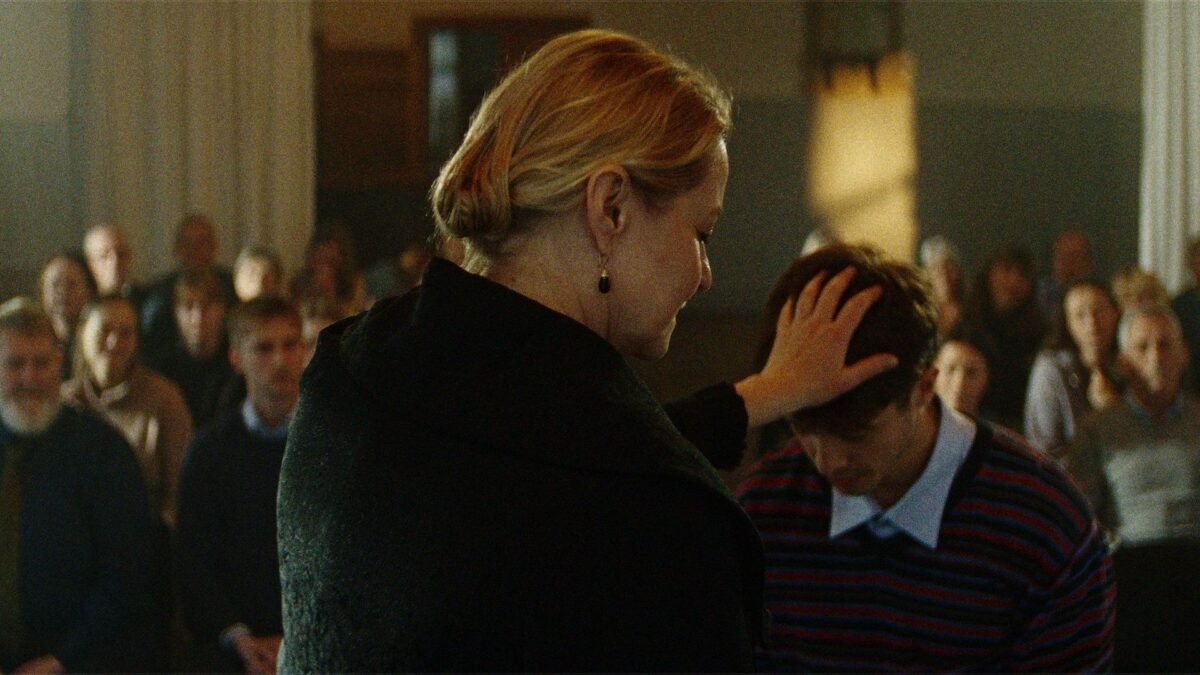
Father’s House cult documentary arrives at the Tallinn Black Nights Film Festival with an unusual method: former members of the Danish Christian sect Faderhuset helped stage their own pasts, working alongside professional actors to reconstruct life inside a tightly controlled community.
The film, titled Faderhuset in Danish, premiered Monday in the Doc@PÖFF International Competition at the 30th edition of the Estonian festival. It is directed by Adam Nielsen, Andreas Koefoed and Eva Mulvad, and DR Sales is handling sales. A Danish theatrical release is scheduled for later this month.
A sect reconstructed from the inside

Faderhuset, or Father’s House, developed in the 1990s into a closed religious group held together by faith, manipulation and abuse, according to the film’s account. It ceased to function as a religious congregation in 2013, with leaders and members moving abroad.
Rather than relying only on interviews or archival material, the filmmakers built scenes in collaboration with three former members. Actors Trine Dyrholm, David Dencik, Laura Kronborg Kjær and Emma Sehested Høeg performed in those reenactments, with the former insiders guiding them through experiences they had lived.
Dyrholm plays Ruth, who led the sect through the 1990s. Dencik portrays Jerry Jensen, a former member. Jensen said he felt well cared for during the entire process and safe throughout.
Acting as inquiry, not imitation

For Dyrholm, the work was less about building a character than about examining the mechanics of control. She described each scene as a joint exploration of behavior, situations and manipulation, undertaken with respect for the three people who had lived those moments for real.
She also rejected a simple portrait of the leader as purely evil. Dyrholm said the woman she portrays could be loving as well as manipulative, and that the film tries to hold both sides in view. That mixture, she suggested, is part of why such control can work.
Jensen said he did not want to be presented as a victim. He stressed the importance of taking responsibility for his own actions, and he asked that his experience be shown in all its complexity. He noted that, strange as it may sound, there were also good times in Father’s House. Everything, he said, is not black and white or simply good and evil.
Safeguards and shared responsibility
Mulvad said protecting the collaborators and their mental health was central, because the project dealt with somebody’s life rather than a game. At the same time, she warned against overprotecting people or taking over their lives, which she described as another form of power demonstration.
She characterized the creative process as a negotiation built on trust and transparency. Because the reenactments recreated painful experiences, a psychologist was available in case the work stirred trauma. Mulvad had known Jensen for many years before shooting, and they discussed and wrote the scenes together in detail.
Beyond one religious group
The filmmakers want the film to reach beyond the story of a single sect. Mulvad argued that sectarian documentaries often let viewers feel superior, as if the people who joined were less intelligent. She wanted to avoid that angle and instead examine how capable people gradually hand over control of their lives.
That process, she said, does not happen overnight and has its own dramaturgy. It becomes more visible in an extreme group, but she sees similar dynamics in dysfunctional families, workplaces and high-pressure sales situations, as well as online. Her point is that no one is automatically immune.
Dyrholm described the film as a layered document of human nature in a brutal form and said she hopes it will push discussions forward, including how young people can be helped out of such communities. She called it a universal story and said she was proud to help tell these people’s story.