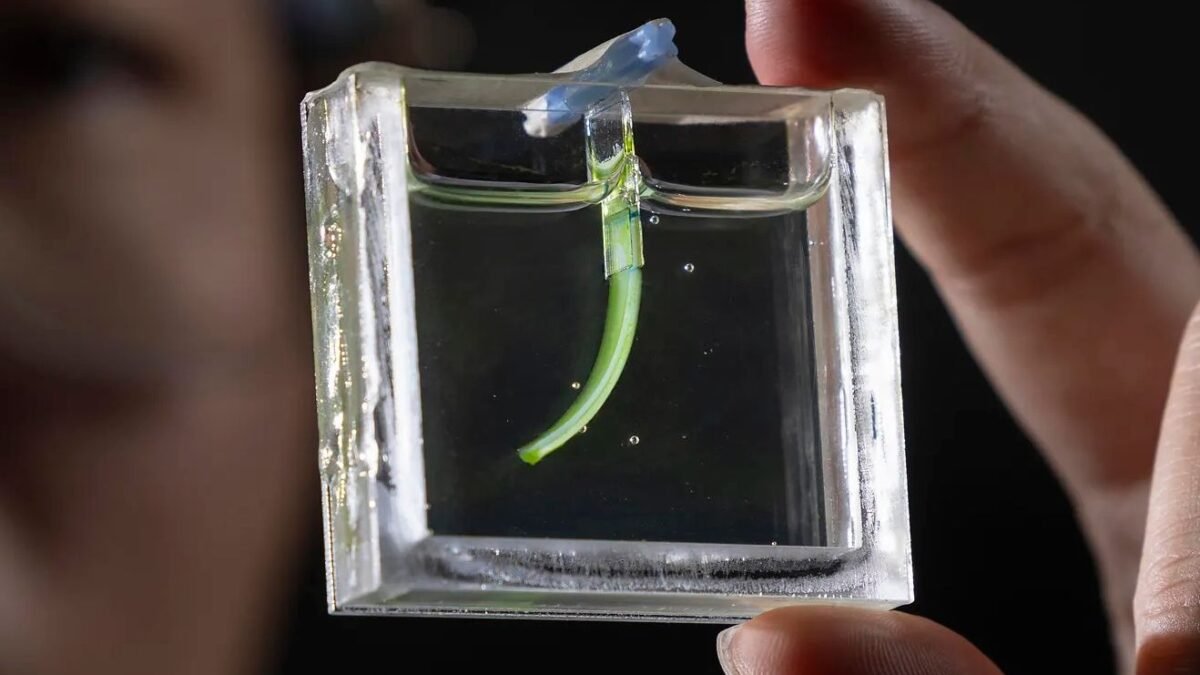
Researchers at Delft University of Technology in the Netherlands have developed algae-powered robotic arms that bend when light shines on them. The tiny devices, roughly three-quarters of an inch long and about as thick as a credit card, rely on the photosynthetic activity of algae living on their surface to generate motion.
The work, led by Marie-Eve Aubin-Tam, grew out of a broader interest in living materials rather than a specific end use. The team set out to see what might be possible when living cells are integrated into functional materials.
How the arms move

Each arm is built from two layers of hydrogel that host the algal cells. One of the layers responds to changes in pH, which the algae’s metabolism alters. When light hits the algae, photosynthesis begins: the organisms absorb carbon dioxide and fix nitrogen, making the local environment more basic. That shift causes the pH-responsive hydrogel to swell. In darkness, the algae respire and release carbon dioxide, pushing the pH back toward acidic conditions, and the hydrogel shrinks.
The differing volumes of the two hydrogel layers produce bending. The researchers found the responsive layer was about 37 percent of its original weight under acidic conditions between pH 3 and 7, but it reached four times its original weight at pH 11.
What distinguishes this approach from earlier pH-responsive soft robots is the scale of the chemical change. Typically, the chemistry of the entire surrounding liquid must be altered to trigger movement. Here, the algae’s activity stays local, which the team says makes the system better suited to applications where minimal environmental impact matters.
Slow but deliberate

These are not fast machines. The chemical shift starts quickly—about 20 seconds after light is applied and about 10 seconds after darkness falls—but the hydrogel needs several hours to bend significantly.
After an initial proof of concept, the team built additional devices. One was a four-fingered gripper that closes when exposed to light; it grasped and lifted a hollow metal sphere and released it when the light was switched off. Another, shaped like a hook, could pick up and set down a rubber ring. The objects weighed far less than a small paperclip, but the arms handled them with notable dexterity.
Self-sustaining and low-impact

The devices need no external energy source beyond light and contain no complex mechanical parts. Aubin-Tam described microalgae as plantlike organisms that are largely self-sustaining, giving the actuator potential for long-term operation with minimal external input. In theory, she said, running a system based on this technology would not require much energy.
Because the algae do not need genetic modification, the biosafety concerns often tied to microbe-based technologies do not apply. The organisms also absorb carbon dioxide from the atmosphere while drawing energy from sunlight.
Looking ahead, the team hopes the work will contribute to more autonomous, environment-responsive soft robots—possibly for automated agricultural equipment, fluid control in lab-on-a-chip devices, or other underwater robotics systems.