Three sanctioned tankers and an Iranian fishing boat have been tracked lingering over major undersea Internet cables in the Gulf of Oman near the Strait of Hormuz, movements that maritime intelligence firm Windward says may signal preparations to attack the infrastructure. The behavior of these Iran-linked ships near subsea cables was observed in October and reported by the Financial Times.
Windward, which used ship-tracking data and satellite imagery, found that the vessels slowed and circled repeatedly near multiple cable corridors. Some later switched off their automatic identification system transponders, effectively going dark. The firm said such patterns could indicate the ships were mapping cable routes or placing charges or mines while invisible to normal monitoring.
Strategic chokepoint for global data
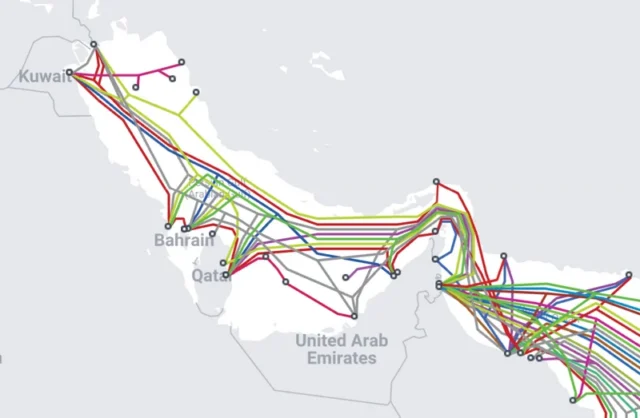
Six active cables pass through the Strait of Hormuz, connecting the Middle East with Europe, Africa and Asia. Two more cables have segments under construction in the region. Iraq, Kuwait, Bahrain and Qatar rely entirely on these subsea links to reach the outside world. India also depends heavily on the route: one third of its westbound Internet traffic travels through the Persian Gulf and the strait.
One of the cable projects under construction, the 2Africa cable, is owned by a consortium that includes Meta. Windward identified that corridor as one of the areas visited by the drifting Iran-linked ships.
In an October 26 blog post, Windward highlighted two sanctioned tankers tied to Iran that spent days drifting directly above regional cable corridors. Neither vessel carried commercial cargo, and the firm noted they had no commercial reason to stop.
IRGC warnings escalate
The ship movements come amid a broader war that began in February 2026, when the United States and Israel launched major strikes against Iran. Iran has retaliated by targeting US military bases, ships and aircraft, attacking commercial shipping in the Strait of Hormuz and hitting oil refineries, energy infrastructure and airports in Gulf countries. It has also threatened or struck US Big Tech infrastructure in the Middle East, including repeated drone attacks on Amazon data centers.
In May 2026, an Islamic Revolutionary Guard Corps spokesperson said Iran would impose fees on Internet cables owned by US tech companies and others. More recently, multiple Iranian officials and IRGC commanders have warned they could directly attack the undersea cables in the Strait of Hormuz. Those warnings followed repeated threats by President Donald Trump to renew major US military strikes and his remark at the United Nations on September 22 that he could annihilate the country.
On October 20, an IRGC spokesperson referred to seven major cables running through the strait and said the enemy was being reminded of that fact.
The latest phase of the conflict has seen more limited US strikes on Iranian targets while Trump has alternated between threats and suggestions of a diplomatic opening. Iran, meanwhile, has stepped up drone strikes and other attacks on commercial ships. October recorded the highest number of ship attacks since the war began.
Repair work stalled and alternatives sought
The war has already disrupted the undersea cable industry. The small fleet of cable-laying ships used for installation and repair has been unable to operate safely in the region since the fighting started, forcing the Meta-backed 2Africa cable to pause its planned expansion.
US technology companies and Gulf nations have responded by accelerating efforts to develop alternative cable routes that bypass the Strait of Hormuz. The Middle East is not alone in facing such risks: subsea infrastructure worldwide is increasingly exposed to sabotage and gray-zone warfare, from the Baltic Sea to the Pacific Ocean.