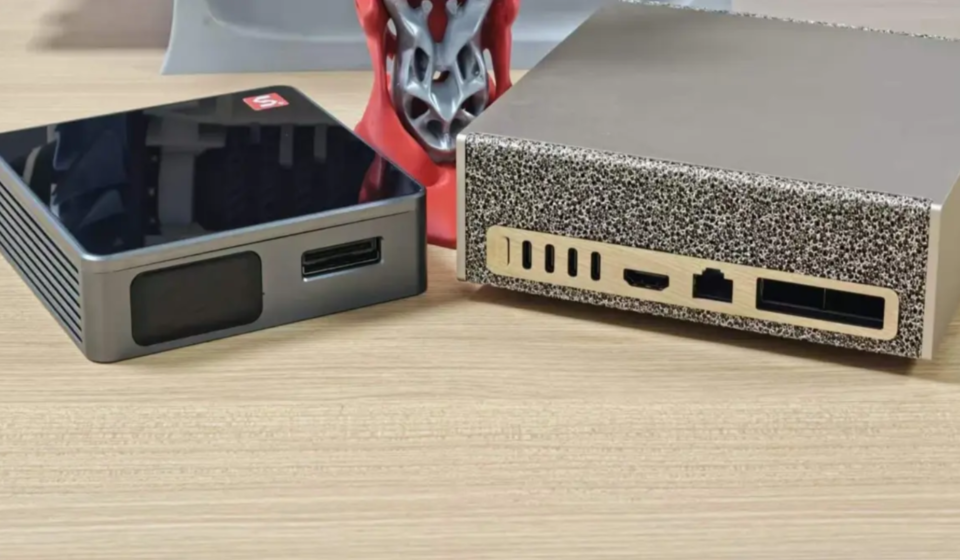

Sipeed has published benchmark claims asserting that its forthcoming Sipeed MaixStation, an AI mini PC built around the Axera AX8860P processor, surpasses Nvidia’s DGX Spark on Qwen workloads. The comparison, which Sipeed says it conducted with speculative decoding and multi-token prediction disabled, gives the 128GB MaixStation a narrow edge. No independent party has yet reproduced the results.
What the AX8860P brings to the table
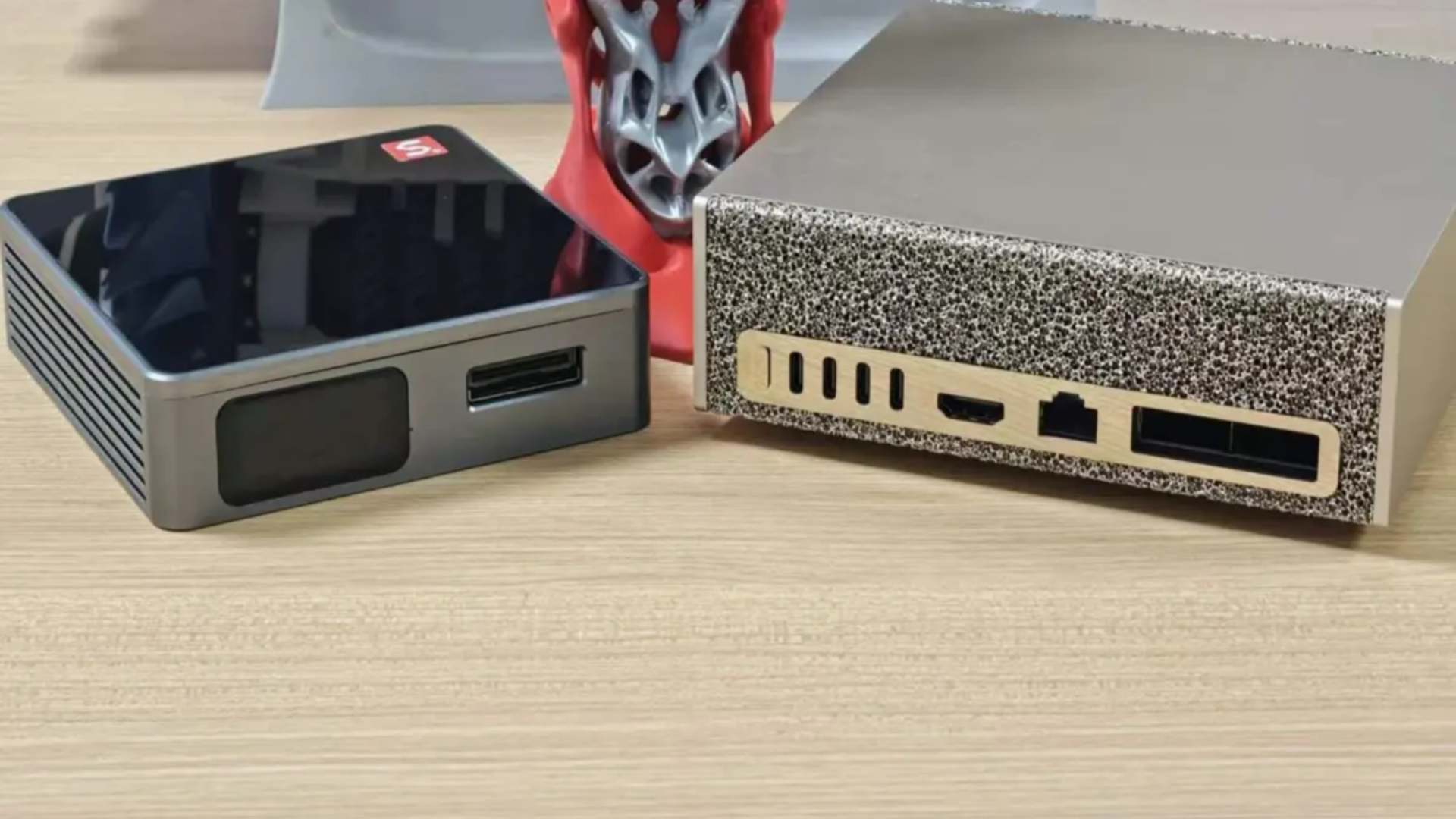
The chip at the center of the claim is not an Nvidia part. Axera’s AX8860P is fabricated on a 6nm process and carries 16 Arm Cortex-A55 cores. Its AI acceleration is rated at 256 TOPS, with typical power consumption listed at 40W.
Memory support runs to 256-bit LPDDR5X, and the platform offers PCIe 5.0 connectivity. Video handling is unusually broad for a device this size: 64 decode channels and 16 encode channels. Axera also supplies an interconnect technology called AXLink, which the company says achieves roughly 80% efficiency when multiple units are linked.
The MaixStation enclosure measures 110 x 110 x 30 mm. Connectivity includes USB 3.0 Type-C and a 10GbE SFP+ network interface, and the unit is powered through 65W USB Power Delivery.
The TOPS argument: 256 against 1,000
On paper, the numbers look lopsided. Nvidia advertises the DGX Spark at 1,000 sparse FP4 TOPS, which works out to roughly 500 dense FP4 TOPS in theoretical terms. Sipeed’s counterargument is that raw TOPS figures overstate what large language model inference can actually extract from the hardware. The company points to architectural optimizations it says improve prefill resource utilization, and it expects future software work to raise throughput further.
Both systems share a 273GB/s memory bandwidth figure, a detail that matters because LLM inference is often constrained by memory movement rather than raw compute. Sipeed’s reported advantage on Qwen is small, and the company itself frames the comparison around practical utilization rather than peak specifications.
Configurations, pricing and the models each tier can run
Sipeed is positioning MaixStation across two main memory tiers. The 32GB entry model is priced below $2,000 and is listed as supporting Qwen3.8-27B. The 128GB version comes in below $4,000 and is aimed at Qwen3.8-Flash-Next 125B.
Larger models are addressed by chaining units together. Two MaixStation systems provide 256GB of combined memory for DeepSeek V4-Flash 284B, while a four-unit Pro configuration offers 512GB for DeepSeek V4.1-Flash 552B.
For comparison, the DGX Spark is reported at $6,949.99, well above the $3,000 to $4,000 range Nvidia originally announced in March 2025.
Software stack and scaling
The software story is built around familiarity. Sipeed lists compatibility with PyTorch, ONNX, vLLM, SGLang and Hugging Face, alongside OpenAI-compatible interfaces and Axera’s development tools. That combination is intended to let existing serving workflows move onto the hardware without a full rewrite.
Scaling depends on AXLink. Axera’s claimed 80% interconnect efficiency is central to the multi-unit pitches, since the two- and four-unit configurations are the only route to the largest DeepSeek models in the lineup.
Availability remains the open question
Sipeed plans to run a Kickstarter campaign within several months. A $30 reservation is being offered with a $100 discount attached. Final retail pricing and a commercial availability date have not been settled.
The benchmark figures themselves also remain provisional. Independent testing has not been performed, and performance on models beyond Qwen is unknown. Actual power draw under sustained load is likewise unverified. Until third-party results appear, the claim that MaixStation outperforms DGX Spark on Qwen should be read as Sipeed’s own position rather than an established result.