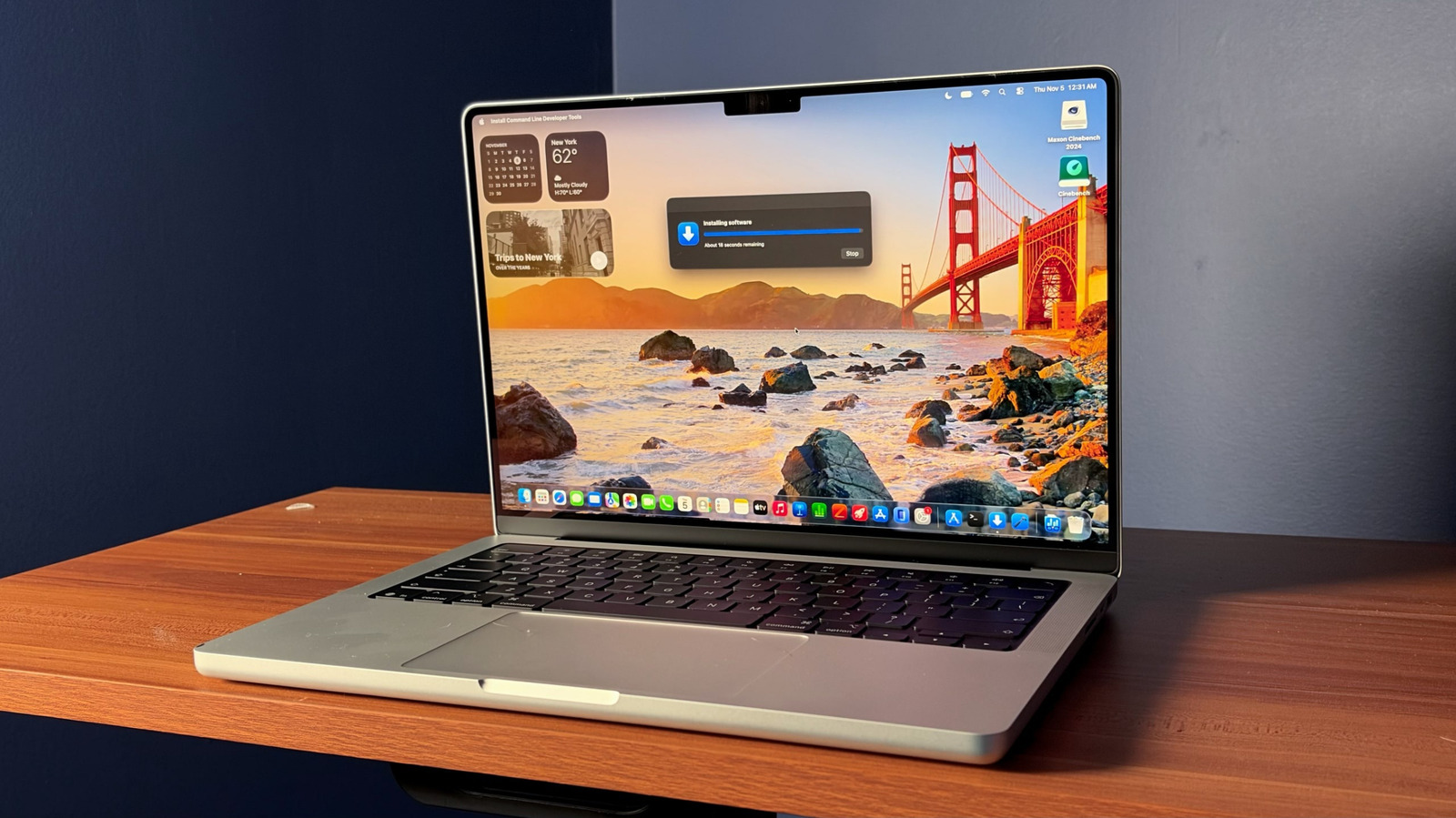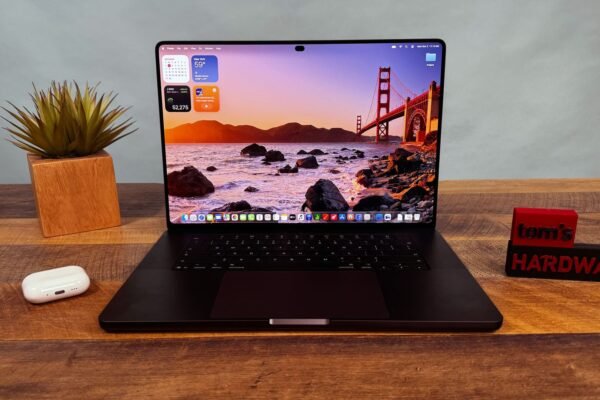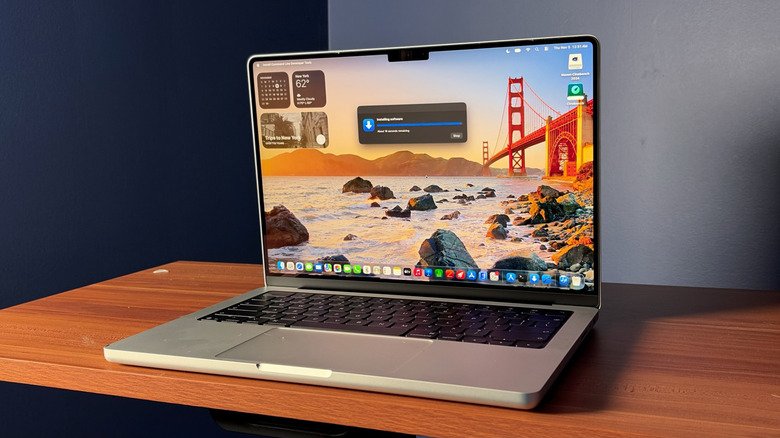
This MacBook Pro M6 review lands at an awkward moment for Apple’s most affordable professional laptop. A week before the company’s touchscreen-equipped PROLED XDR models arrived, the M6 machine was quietly announced, and it is those flashier systems that will dominate holiday marketing. Yet the $1,999 14-inch model remains the cheapest way into Apple’s Pro-grade lineup, and for most buyers it is still the sensible choice.
What the M6 chip brings
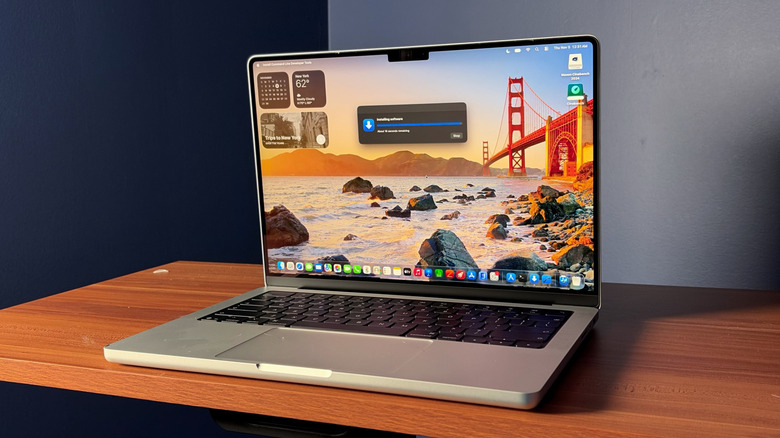
The headline change is Apple’s M6 system-on-a-chip, already seen in the recent Mac mini. It pairs a 12-core CPU with a 12-core GPU, up from the M5’s 10-core CPU and 10-core GPU. The CPU splits into two super cores for single-threaded work, four performance cores for heavier multithreaded loads, and six efficiency cores for background tasks. Apple also includes dual 16-core neural engines for the first time, claiming AI tasks run twice as fast as on the M5.
Apple’s own comparisons suggest the gains are modest. The company says the M6 is 11.7 times faster at 3D rendering than the original M1 MacBook Pro, while the M5 was 9.2 times faster. In Cyberpunk 2077, the M6 is reportedly 3.2 times faster than the M1, versus 2.5 times for the M5. Anyone already using an M5 machine has little reason to upgrade.
Buyers who need more headroom must step up to the M5 Pro or M5 Max, which remain the top-end options until faster M6 Pro and Max chips arrive. Those chips also support more and faster memory: the M6 tops out at 32GB running at 170 GB/s, while the M5 Pro can hold 64GB at 307 GB/s.
A familiar shell that still holds up
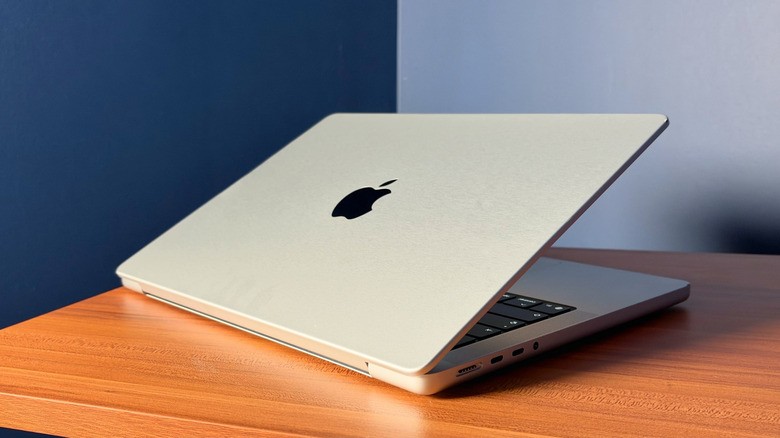
Beyond the chip, the 14-inch model carries over the same hardware. The MiniLED Liquid Retina display refreshes at 120Hz through ProMotion, the unibody case feels solid, and the port selection is generous: three Thunderbolt 4 USB-C ports, MagSafe charging, HDMI, a headphone jack, and an SD card slot. At 3.4 pounds, it is not dramatically heavier than the 3-pound 14-inch PROLED model.
None of this is new, but familiarity is not a flaw. Apple’s build quality has long set a benchmark for PC makers, and this machine benefits from years of refinement.
Everyday speed and battery life
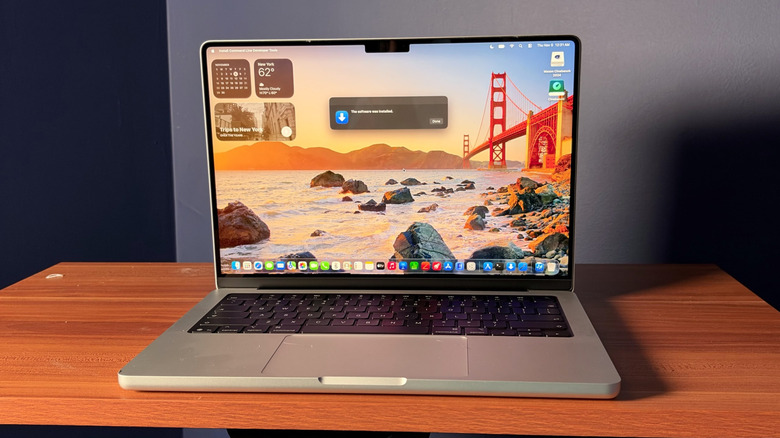
The review unit, configured with 16GB of RAM and a 1TB SSD, handled a daily workflow without noticeable slowdown. That has been true of MacBook Pros for years, and the M6 is only slightly quicker than its predecessor.
Benchmarks tell a similar story. In Geekbench 6, the M6 scored 4,458 in single-threaded work and 19,077 in multi-threaded tasks. The M5 14-inch model scored 4,310 and 18,003 respectively. Graphics showed a clearer jump: the M6 reached 64,115 in the Geekbench 6 GPU test, compared with 48,840 for the M5. In Cinebench R24 multi-threaded testing, the M6 was roughly 30 percent faster.
Gaming benefits too. Lies of P ran between 90 and 100 frames per second at the full 3,024 by 1,890 resolution with settings maxed out, a 25 fps gain over the M5 that is unlikely to be noticed during play.
The touchscreen on the PROLED model was not missed. The large trackpad remains easier for scrolling through pages and documents. The MiniLED screen is dimmer than the PROLED panel but still renders photos and video well, and it stays readable in direct sunlight.
Battery life remains a strength. The M6 MacBook Pro lasted 9 hours and 35 minutes in the MacBatteryBenchmark script, which simulates programming workflows. In mixed testing with dozens of browser tabs, editing, and video calls, the battery hit 50 percent after six hours.
Who should buy it
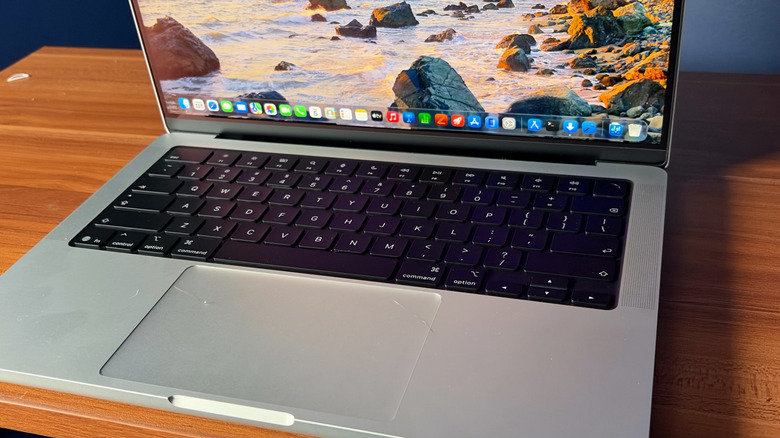
The price has risen from $1,599 to $1,999 over the past year, which is disappointing. Even so, the 14-inch M6 MacBook Pro is the least expensive Pro laptop Apple sells, and it is the model most people should consider unless they are shopping used or refurbished.
It is fast enough for content creation, gaming, and demanding work that would strain a MacBook Air. The decision gets harder at the $2,499 M5 Pro configuration. At that point, spending a little more for the redesigned $2,899 PROLED MacBook Pro, which also uses an M5 Pro chip and weighs less, starts to make sense.
Apple’s strategy of selling several MacBook Pro generations at once may not last forever. For now, the base 14-inch model remains a strong choice: quick enough for most users, and a clear step up from the MacBook Air thanks to its ProMotion MiniLED screen, active cooling, and wide port selection. The M6 version adds little, but it is still one of the best laptops available.