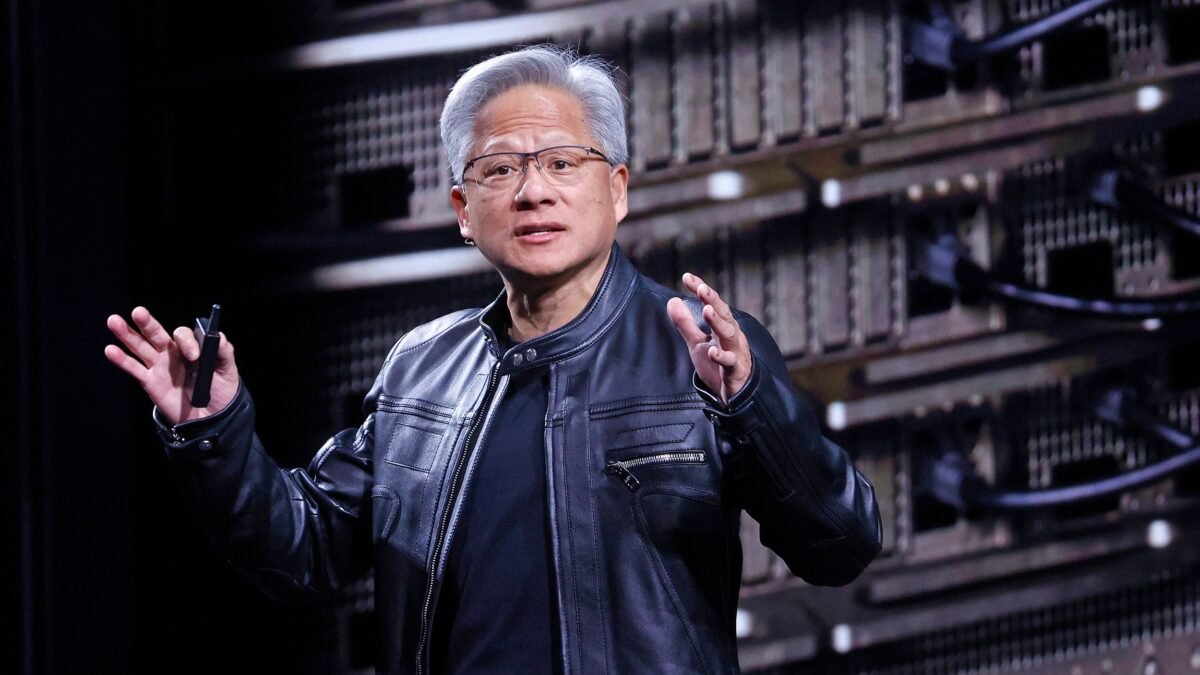
The Jensen Huang affair inquiry has thrust Nvidia’s chief executive into an unfamiliar spotlight, one focused not on product launches or artificial intelligence breakthroughs but on national security and corporate governance. The scandal, which centers on his admitted relationship with a woman identified by U.S. intelligence as a Chinese intelligence asset, now threatens to disrupt the company’s leadership and the broader AI sector.
A CEO at the Center of the AI Boom

Few executives have shaped the artificial intelligence era as directly as Jensen Huang. Since co-founding Nvidia in 1993, he has built the company into a dominant force, controlling roughly 90 percent of the market for chips used to train frontier AI models. That market position has given him unusual influence over which AI projects advance and which struggle to secure hardware.
His reach extends well beyond Nvidia’s campus. Huang has become a close confidant of President Donald Trump and a prominent voice in U.S.–China relations. He has also invested billions of dollars into companies that buy Nvidia chips, including OpenAI and Anthropic, effectively bankrolling much of the AI buildout. When Elon Musk needs a new data center, he can reportedly call Huang directly.
Internally, Huang’s management style is famously hands-on. Current and former employees say he responds to emails from any of the company’s roughly 60,000 staff members, closely manages small details, and raises his voice to make his points. He is a regular on cable television and at tech conferences, where he has sought to calm concerns about an AI bubble while promoting Nvidia’s position.
The Relationship and the Board’s Review
The affair came to light after Huang admitted the relationship with Alice Huang, an executive at a Singapore-based company. U.S. intelligence services concluded she was a Chinese intelligence asset. Nvidia’s board of directors has said it will launch an investigation into the incident, and Huang has pledged to cooperate.
Huang earned $36 million last year and owned about 3.5 percent of Nvidia as of March, according to a corporate filing. That same filing noted that Huang is an at-will employee who can be terminated at any time without severance. The board’s review will likely examine whether Huang violated any company policies, according to David Yoffie, a professor at Harvard Business School who tracks the chip industry. The FBI could also investigate whether any laws were broken, and Congress may examine whether the affair influenced U.S. policy on selling chips to China.
Nvidia shares fell more than 4 percent on Monday, even as broader stock market indices rose.
No Clear Successor
Huang’s prominence inside Nvidia is unmatched. There is no apparent potential successor, a fact that complicates any leadership transition. “We have no idea who would replace him,” Yoffie said. “You put someone new into that position, if you’re a customer, who knows what that’s going to mean.”
Ryan Fedasiuk, a senior fellow at the Foundation for American Innovation, described Huang as load-bearing for the entire U.S. AI industry. “On the one hand, Huang is irreplaceable. He built Nvidia into the juggernaut it is today, and he was the visionary behind the GPU, which has sustained the intelligence revolution,” Fedasiuk said. But he added that Nvidia itself must come first. “He has to be replaceable as the CEO of the world’s largest company, at $4 trillion in capex.”
Export Controls and National Security
The timing of the scandal is particularly sensitive given Huang’s outspoken stance on technology export controls. In recent years, he has argued against more aggressive restrictions on China. Both the first Trump administration and the Biden administration imposed controls designed to limit China’s access to Nvidia chips and the technology needed to make advanced semiconductors. In his second term, Trump loosened some of those controls, allowing China to access older generations of Nvidia chips on the argument that it was better to make China reliant on U.S. technology.
Sam Bresnick, a research fellow at Georgetown University’s Center for Security and Emerging Technology, said the scandal is likely to accelerate efforts to crack down on chip exports. “There was going to be more of an impetus to control what chips are getting sent to China anyway,” he said. “I expect there to be more scrutiny on what’s going on, what’s getting sent to China. I think there’s also going to be more scrutiny from the Commerce Department.”
Fedasiuk also raised concerns that China may have gained sensitive information about U.S. AI companies and the government’s strategy toward China. Huang’s credibility on export policy could be permanently damaged.
For now, the board’s investigation will determine Huang’s future at the company he built. What remains clear is that the outcome will reverberate far beyond Nvidia’s headquarters, touching the AI industry, U.S.–China relations, and the global chip supply chain.