California voters have rejected a one-time California billionaire wealth tax, ending a closely watched ballot fight that took nearly a week of counting to resolve after the midterm election.
The proposal, known as Proposition 40, would have imposed a 5% levy on the total wealth of residents worth more than $1.1bn (£800m), encompassing income as well as assets such as shares. It failed amid splits among Democrats and labor unions.
What the measure would have done

Had it passed, Proposition 40 would have raised an estimated $100bn, according to supporters, to help fill gaps in healthcare funding left by federal cuts tied to President Donald Trump’s tax and spending legislation. Experts believed the measure would have been the first wealth tax anywhere in the world aimed specifically at billionaires.
California is home to roughly 200 billionaires, a group that includes Meta’s Mark Zuckerberg, television personality Kim Kardashian and media figure Oprah Winfrey. The state also has one of the widest wealth gaps in the country, alongside the largest US economy and the fourth-largest economy globally.
Opposition from powerful quarters
The tax drew fierce resistance from several directions. Governor Gavin Newsom, whose tenure is nearing its end, warned that the measure could prompt wealthy residents to leave California and take their income tax revenue with them. Labor unions also opposed the proposal.
Google co-founder Sergey Brin was among the most prominent financial opponents. According to the Los Angeles Times, Brin gave more than $100m to a political organization that funds ballot measures capable of blocking the tax. Some billionaire critics spent millions trying to defeat the measure, and a handful relocated out of state to avoid the potential liability.
The ballot also included two other propositions that would have effectively reversed the wealth tax even if it had passed, stacking the odds against it.
Supporters vow to return
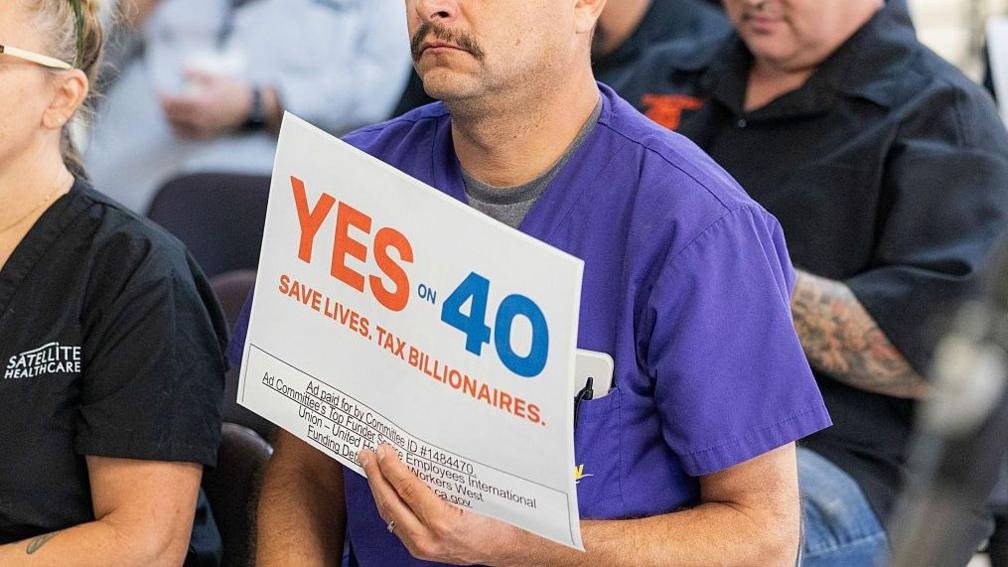
Dave Regan, president of Service Employees International Union-United Healthcare Workers West, which led the campaign for the measure, said on election night that the billionaires’ opposition created widespread uncertainty and second-guessing among voters who knew what the right course was. He pledged to pursue a billionaire tax again in 2028.
The outcome leaves California’s healthcare funding gap unresolved and signals that even in a state with one of the world’s highest concentrations of ultra-wealthy residents, taxing billionaires remains a steep political climb.