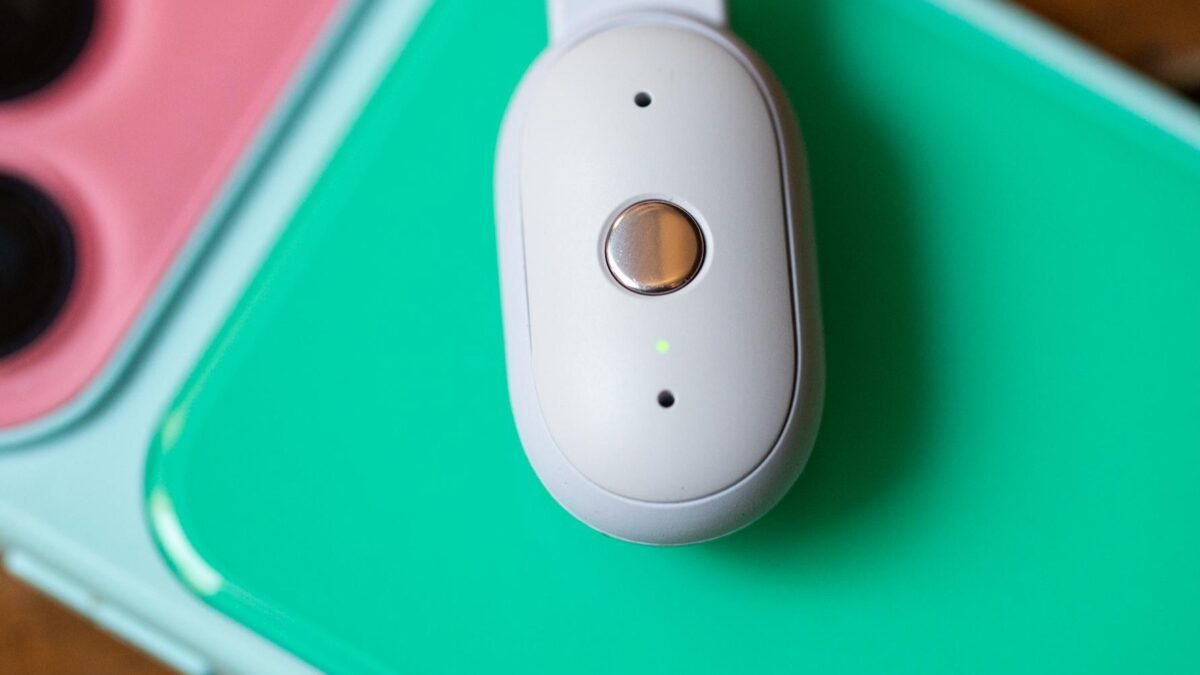
After nearly a month of wearing an always-on AI pendant, I have a new benchmark for how a gadget can leave me feeling unmoored: an Amazon Bee Frontier review that ends with me questioning which version of events to believe.
The Bee Frontier listens to conversations, transcribes them, and uses AI to generate summaries, to-do lists, and “facts” about its wearer. It is designed to be forgotten, which is exactly what makes it so disorienting. During a therapy session, I had to ask my therapist for consent because the pendant was recording. By the third week, she suggested I throw it out a window.
What the Amazon Bee Frontier Actually Does

Bee is an always-recording wearable pitched as a memory aid. It captures speech, then processes it through AI to produce transcripts, summaries, and suggestions. A feature called List recommends tasks. Another called Grow offers personal-development insights based on conversation history. A chatbot answers questions about what was said and when.
Since I first tested the device early last year, it has improved at separating live conversation from television dialogue. It can pull in calendar and data, and it can suggest Amazon purchases based on spoken cues. In some work situations, it has helped me recall talking points. Most of the time, it has made me second-guess my own recall.
The errors range from funny to unsettling. Bee has concluded that I frequently argue with a coworker’s spouse I have never met. It has recorded that I believe a family member has undiagnosed bipolar disorder, which no one ever said. It has attributed a joke about wearing good pants for video calls as a preference. It has also multiplied my two cats into a household of eight by treating their nicknames as separate animals.
When a Transcript Becomes a Trigger

I grew up in an immigrant family that never agreed on a single version of events, and with a father who might have been a spy. I spent years unsure whether my parents were unreliable narrators or I was. Dementia later made the line between truth and fiction even harder to find. I once wished for a device that could provide a reviewable record for moments when I needed a sanity check. Now that such devices exist, I often feel gaslit.
During a therapy session, I discussed a film about compulsive liars that had stirred up difficult memories. I had forgotten to turn Bee off. Afterward, the device generated a “fact” about a childhood instance of domestic violence. I had to swipe right to confirm it was true. The summary was titled “Reclaiming Reality from Manipulative Power,” and it described me as deeply unsettled and the conversation as intense and emotionally raw. I remembered the session as cathartic, with moments of laughter. The AI remembered it as something closer to a breakdown.
I also forgot to turn Bee off during an annual physical. It recorded my doctor’s allergy prescription and a conversation about my deceased dog, Daisy. It described me as wistful and grieving; I remember fond remembrance. Depending on which template I applied, the same appointment could read as a tonal analysis or a stripped-down medical record. The factual version was more useful. It also felt like a different appointment from the one I attended.
The Grow Feature Turns Hobbies Into KPIs

Bee’s Grow feature compiles recommendations for self-improvement. To train the AI on my voice during setup, I described my hobbies: reading, calligraphy, cross-stitch, and running. I recently started using fountain pens and ink swatching for journaling. Because the prompt required about two minutes of speech, I rambled about whether embroidery would be a natural next step from cross-stitch.
Grow concluded that I dabble in too many hobbies without serious commitment, that I show no tangible sign of “shareable output,” and that I should spend three months choosing one. It also noted that despite calling myself a reader, I had not made much progress this year, based on an old to-read list in my reminders. I have finished 39 books in 2026 and completed 10 cross-stitch projects. Hobbies, I happen to believe, should be exempt from Silicon Valley performance metrics.
Another Grow insight came from a conversation with my spouse about the midterms. It described my tone as analytical rather than activist and suggested I complete one concrete political action in under 30 minutes. In my memory, the conversation was a joke after watching an episode of The Daily Show. I have canvassed and worked as a union organizer and representative.
Why Intelligence Cannot Replace Wisdom

My therapist’s assessment was more useful than any summary Bee produced. She said a device like this can supersede a person’s ability to trust their own instincts about what they need to do. When that instinct is outsourced, AI can generate insights that are not emotionally attuned and can worsen the very problems a person is trying to solve. For me, it triggers rumination, spiraling, and perfectionism.
That is where the suggestion to throw the device out a window came from. We laughed about how relieved we would both feel when I arrived at my next session without it. That was the most important takeaway of the experiment. Bee did not include it in my suggested to-do list. It did, however, tell me to buy nail glue, with a link to Amazon.