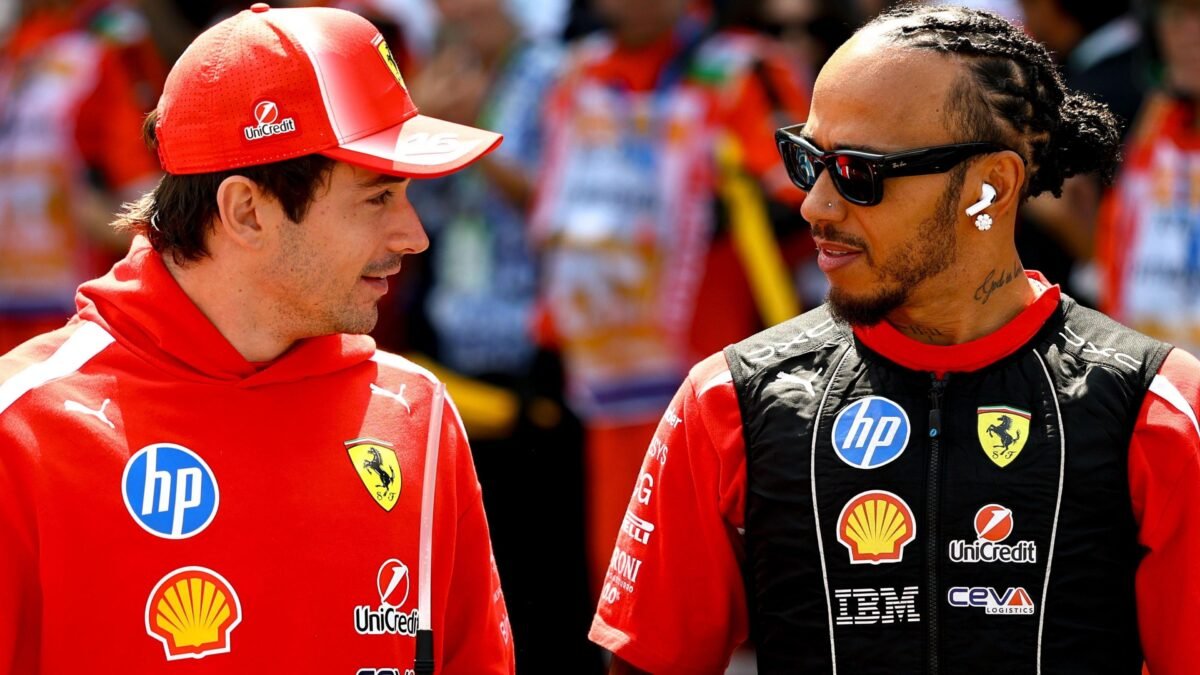
The Hamilton-Leclerc tension has resurfaced at the worst possible moment for Ferrari, with the team trying to close out a season of progress while managing a driver pairing that cost it dearly in Mexico. Lewis Hamilton and Charles Leclerc collided on the opening lap in Mexico City, turning a likely one-two into an opportunity Max Verstappen accepted by winning the race.
That incident prompted Hamilton to say the team had serious issues requiring proper discussion. Those talks took place on Thursday evening in Brazil, after Leclerc and team principal Frederic Vasseur had returned to Europe between races. Vasseur’s public assessment was that the meeting went well and clarified positions, but he also acknowledged that Ferrari had failed and needed to respond.
Ferrari’s priority is clear

Vasseur stressed that the team’s guidelines remain unchanged: the drivers must respect each other, the brand and the people working both at the factory and at the track. His message was that Ferrari comes first, and that the competitive spirit between Hamilton and Leclerc cannot be allowed to override the team’s interests.
The difficulty is obvious. Hamilton has been particularly direct about the contrast between how Leclerc raced him in Mexico and how he believes Leclerc approached Verstappen in Singapore, where the two ran side by side towards the first corner. Hamilton also suggested this was part of a pattern he had observed between Leclerc and previous team-mates Sebastian Vettel and Carlos Sainz.
Hamilton made clear he does not intend to soften his approach. He said he speaks honestly in the moment, has not been asked to stay silent and will continue pushing for changes. He described himself as outspoken and said that is simply how it will be while he is at Ferrari, because his goal is to win.
Why the stakes are higher now

Ferrari’s handling of this problem matters because the team believes it could be a championship contender next year. The source of that belief is the chassis advantage Ferrari has held this season, combined with the need to bring its power unit up to the level of Mercedes and Red Bull. Hamilton said he is working with the aerodynamics leadership to preserve the car’s strengths and address small areas that could be improved, while hoping the engine side delivers.
The season has already shown how quickly the competitive can change. Mercedes dominated the first third, winning seven of the first eight races. Since then, Ferrari, McLaren and Red Bull have all taken turns at the front. Across the past 12 races, Mercedes have won six, Red Bull three, McLaren two and Ferrari one.
Mercedes’ immediate target in Sao Paulo is the constructors’ championship. The team needs three more points than Ferrari to secure it, a result that would underline its return to the kind of form it showed for much of the 2010s.
Verstappen’s surge and the fight behind

Red Bull’s season has been a striking turnaround. Verstappen’s victory in Mexico was his third in four races and lifted him to second in the drivers’ standings, a position that seemed remote when the team was struggling early in the year. He said the result was a surprise but one he accepts, and credited the team for continuing to push and understand its difficulties rather than settling for midfield positions.
The battle for second is tight. Verstappen leads Hamilton by two points, Hamilton is nine clear of George Russell, and Russell is five ahead of Leclerc. None of the four is especially focused on second place, but the position matters as motivation for next season. The constructors’ fight for third is also significant: Red Bull and McLaren are separated by 17 points, with a substantial amount of prize money at stake.
McLaren’s search for another step

McLaren arrive in Brazil with upgrades and hope of closing the gap to the front. Lando Norris was fastest in first practice, and he said the car’s Sunday pace has not been far away in recent weekends. He identified driveability as a weakness but believes the potential is there if the upgrades can improve qualifying and give the team a better race opportunity.
McLaren knew before the season that it had compromised its 2026 programme to ensure it won the championship last year. The car also has inherent issues the team was not aware of before the season began, including gear ratios that are too short, excessive drag and a smaller than ideal wheelbase. Those can be addressed for next year, when the team also expects to be less hampered by a lack of knowledge about power-unit operation under the new engine rules.
Calendar uncertainty beyond Brazil

After Brazil, three races remain on paper: Las Vegas, Qatar and Abu Dhabi. Doubt surrounds the two Gulf races because of the war in the Middle East. MotoGP, owned by the same US group that runs Formula 1, is in Qatar this weekend and has issued personnel instructions for how to behave in the event of a missile strike. Formula 1 has been speaking to governments and security experts and feels it has done what it can to obtain assurances, but the deadline for a decision is approaching.