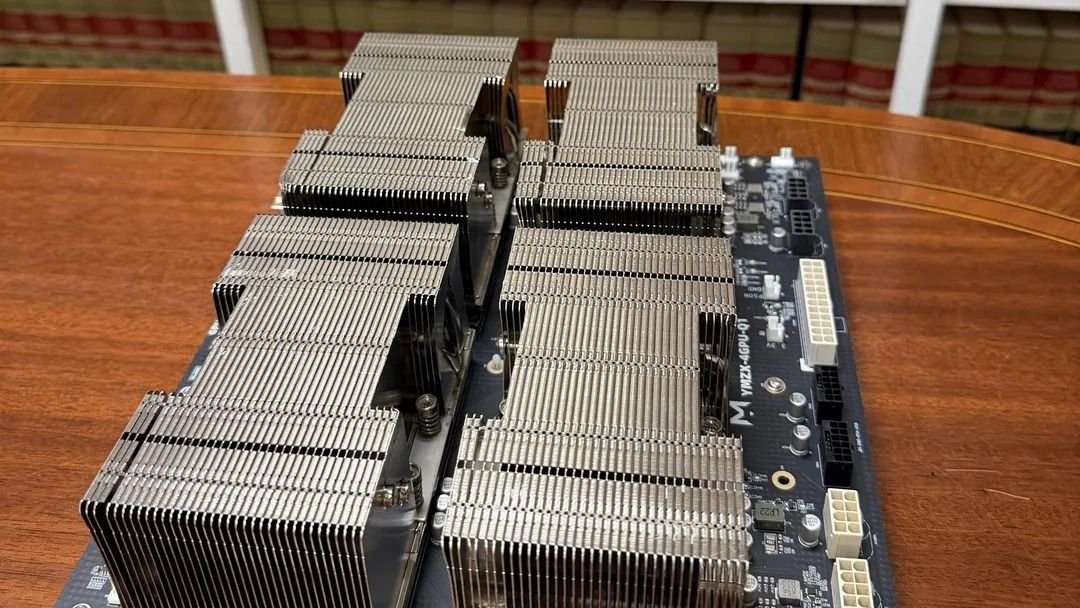
A working lawyer has assembled a private AI server V100 GPUs setup that keeps client case files inside the office. The machine runs eight used Nvidia Tesla V100-SXM2-32GB cards, each carrying 32GB of HBM2 memory at 900 GB/s, and serves the open DeepSeek V4.1 Flash model at speeds reaching 215 tokens per second on code.
Two Boards, One PCIe Bridge
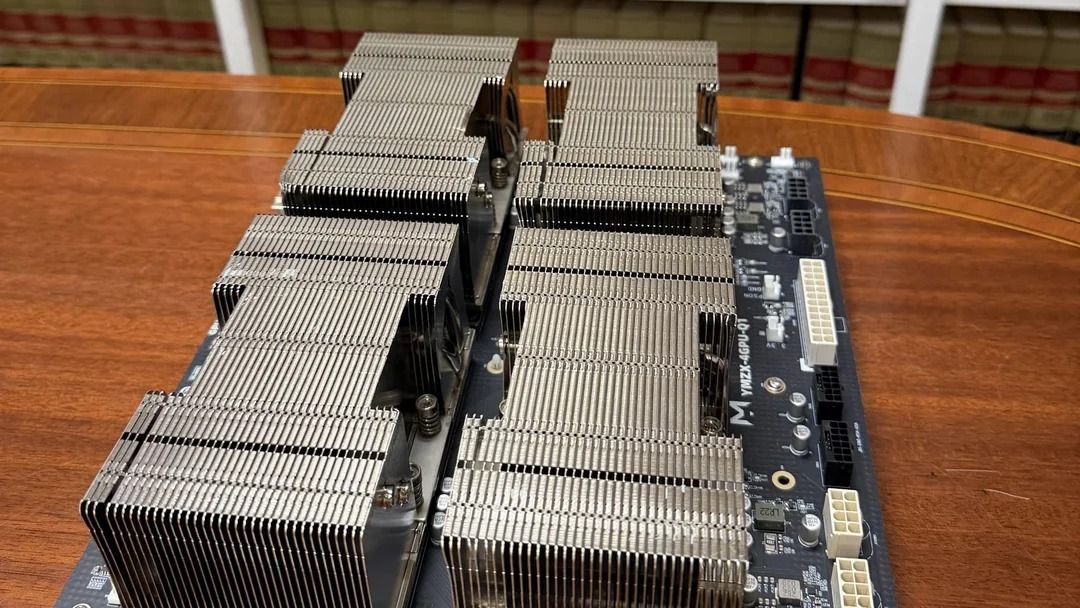
The eight cards sit on two four-GPU SXM2 baseboards rather than PCIe slots. Inside each board, the four GPUs are joined by NVLink, giving 128GB of pooled memory per board. The two boards talk to each other only through PCIe. Each board reaches the host through two PEX switch cards over SlimSAS cables, for four switches total; each switch carries two GPUs at PCIe 3.0 x8 speeds and uses its own x16 uplink.
The builder paid roughly $2,400 per four-GPU board. That window has closed: used V100 SXM2 32GB cards now list on eBay for about $900 each, more than double the roughly $400 apiece cited in the original post, and listings point to further increases.
Model Layout and Speed
DeepSeek V4.1 Flash is compressed to mostly 2 bits and still weighs 248.8GB. Its expert layers stay entirely in GPU memory, while about 110GB of lookup tables, called Engram tables, remain in system RAM. Pulling from RAM costs about 0.12 milliseconds per step, which the builder says has little effect on throughput.
Layers 0 through 19 run on the first SXM2 board and layers 20 through 39 on the second. Each board carries its heavy traffic over local NVLink, so only one hand-off per step crosses the slower PCIe link. An earlier attempt to spread every layer across all eight cards caused speeds to collapse because of that PCIe hop.
Code generation benefits from a small built-in draft model that guesses five tokens ahead, pushing output to 215 tokens per second. Legal writing, the machine’s actual purpose, reaches up to 118 tokens per second. Prompt reading runs at about 2,200 tokens per second, so a 128K-token prompt takes roughly a minute before the first token appears. The model accepts up to 524K tokens of context.
Three days before the post, the same model on four cards managed only 36 to 38 tokens per second. Adding the second board, along with custom kernels and prefill work, produced the jump.
Power, Clocks and a Burnt Connector
The build did not come up cleanly. The host reset twice with a fatal PCIe error on the link to one GPU board, both times with a higher power limit and uncapped clocks. In that state the cards drew 192 to 232 W, above the 180 W limit. The builder suspects, without proof, that a board stops responding during load spikes.
The resets stopped after clocks were capped and one board with a burn mark on its power connector was removed. Each card now runs at a 150 W cap, half its 300 W rating, with graphics clock held to 1522 MHz. A 200 W cap brought no meaningful performance gain in testing.
System memory also threw uncorrected ECC errors, which cleared after RAM was dropped from DDR4-3200 to DDR4-2666. One GPU was linked at x4 instead of x8 at last check, and the builder plans to reseat it; another user traced a similar V100 fault to a bad cable.
Daily Work and Limited Concurrency
The server handles first-pass work on case files: it reads a folder of records, extracts facts, dates and numbers, summarizes them, and produces an initial draft of routine documents. Nothing leaves the office without human review, and keeping files local matters for matters where client data cannot go to a cloud provider or a frontier model.
RAG databases and tool calls are wired in. The operator drives the system through a Discord-style interface over SSH from a Windows PC. For now it processes one request at a time; a two- or three-request version has been built and checked on a test system but not yet deployed on the server.
The rest of the platform includes a Gigabyte Threadripper Pro motherboard with a 12-core 3945WX CPU, 8x 32GB DDR4 RDIMM on one NUMA node, and two power supplies totaling 2,800 W on separate ordinary office circuits. A second DeepSeek server on two DGX Sparks hands work back and forth with the V100 box.
The builder estimates 50 to 60 percent of existing LLM workflows can now run locally instead of on frontier models. The setup appears to save money against API pricing, though the builder says it is not really faster. A 240 V circuit may be added. The system also depends on Nvidia’s R580 driver branch, the last to support Volta. For now the lawyer calls it mostly a hobby, with a possible business idea ahead.