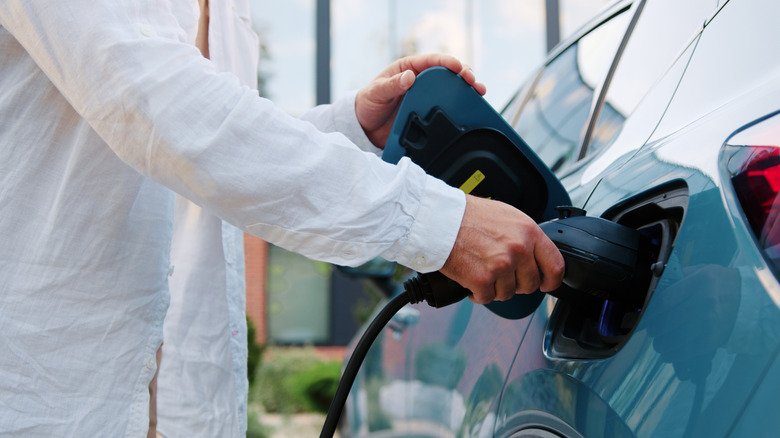
If you have ever watched an electric car’s charge rate tumble on a public charger, the EV fast charging slowdown is not a malfunction. It is a deliberate response to what happens inside the battery cell once it is mostly full. Automakers advertise charging times from 10 to 80 percent for a reason: the last fifth of the pack takes disproportionately long, and pushing current through it at full speed would damage the battery.
What fast charging actually does
Every charging method — a household wall socket, a home or public charging station, or a fast-charge unit — moves electrons toward the battery. Inside the cells, lithium ions travel from the cathode and settle into the anode. When the car drives, those ions move back to the cathode and release current. Charging is simply the process of pushing the ions back into the anode.
The methods differ in how much power they can deliver. A wall socket provides a trickle. A home or public station supplies several times more. A fast-charge station typically delivers 50kW to 350kW, with the newest units going higher.
There is a second, less obvious difference. Wall sockets and charging posts supply alternating current, so the car’s onboard charger must convert it to direct current — and that small converter limits the speed. A fast-charge station performs the conversion in a large cabinet that does not have to fit inside a vehicle, then sends direct current straight to the battery. The car simply tells the station how much it can accept.
Why the final 20 percent takes so long
Chargers push a constant current until the cell reaches its voltage limit. At that point, the charger holds the voltage steady and lets the current fall. This transition tends to occur around 80 percent state of charge.
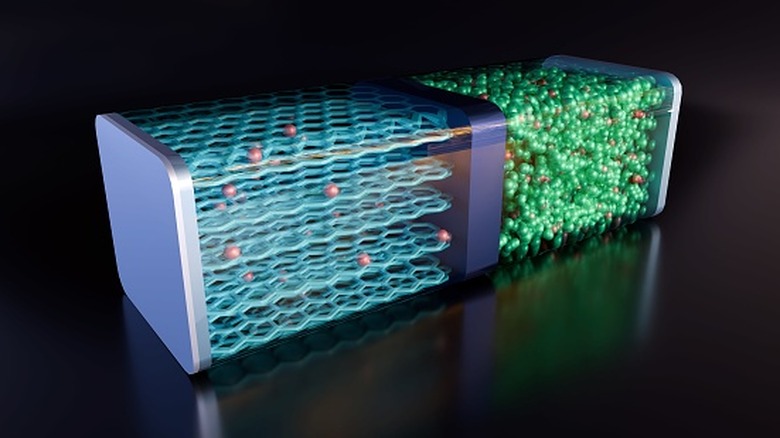
The reason is physical crowding. The anode is mostly graphite, and lithium ions must work their way into it. Early in a charge, most of the anode is empty and ions settle quickly. As it fills, each new ion has to find one of the few remaining spots, and the process slows. Once the anode is nearly full, the lithium takes even longer to settle.
A useful comparison is passengers boarding a bus. A faster charger is like opening the door wider — more people enter per second, but no extra seats appear. When the bus is mostly full, each new passenger must squeeze down the aisle and wait for others to shuffle along. Forcing more people through the door only creates a jam at the entrance. A battery behaves similarly, so past roughly 80 percent the car asks the charger to reduce current.
The risk of forcing a full charge
Ions are not passengers, and that distinction matters. If a charger forces current into an already crowded anode, lithium ions accumulate at the surface faster than they can move inward. With nowhere to go, they deposit on the graphite as a thin layer of metallic lithium. This is called lithium plating.
Plating is partially irreversible, meaning the battery permanently loses lithium it needs. The metal can also grow into spikes that may eventually cause a short circuit. Carmakers therefore slow the charge well before any damage occurs.
How one automaker moved the slowdown later
BYD recently announced a battery it says can charge to 97 percent in nine minutes. Rather than forcing ions harder into a crowded anode, the company redesigned the path they take. The second-generation Blade Battery, unveiled in March 2026, rebuilds the graphite so its particles stand upright, giving ions a short, straight route instead of a winding one. BYD also changed the liquid through which the ions travel so they move more easily, and adjusted the other side of the battery so they can leave faster.
According to BYD, the result is lower internal resistance and less heat, allowing the battery to accept far more current. Paired with the company’s 1,500kW Flash Charger, the battery goes from 10 to 70 percent in five minutes and from 10 to 97 percent in nine minutes. The slowdown still exists — it simply begins much later and ends much sooner.
What drivers should take away
The tapering charge rate is not evidence of a failing pack or poor charging habits. It is the cell protecting itself from lithium plating and the wear that comes with it. For everyday driving, the first 80 percent is the practical window; the final stretch is best reserved for when a full charge is genuinely needed.