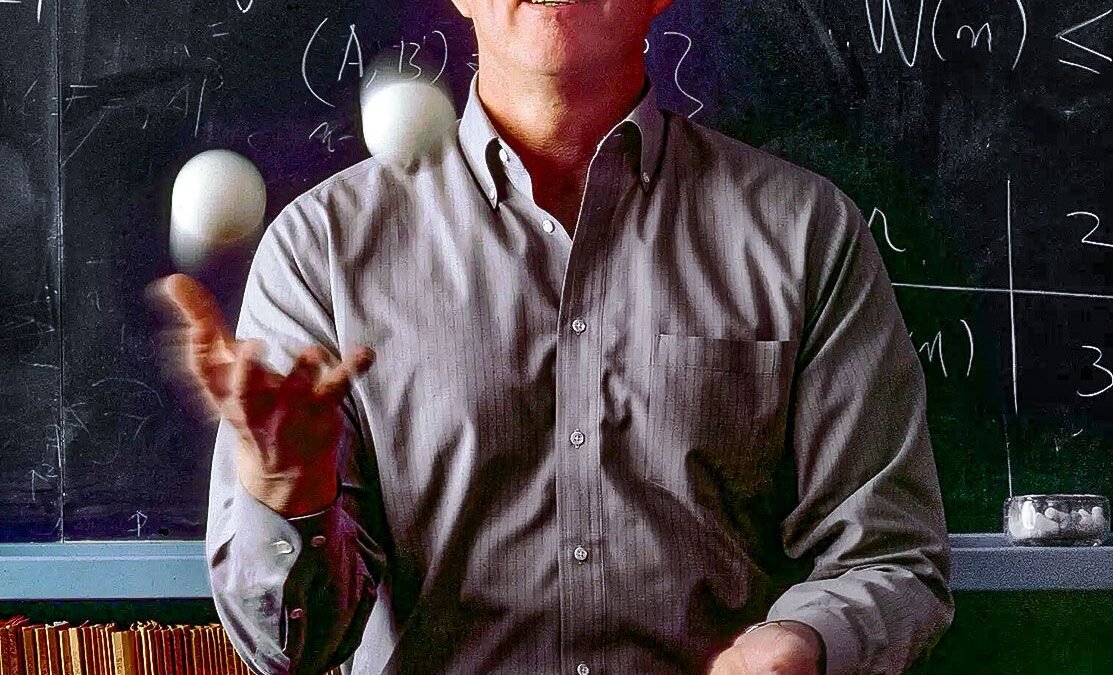
The Graham conjecture solved a 55-year-old mathematical puzzle first pondered by the late Ronald Graham, a renowned mathematician and avid juggler. The problem asks whether any set of distinct nonzero integers in a finite, clock-like number system can be rearranged so that all partial sums are unique.
Graham, who served as president of both the American Mathematical Society and the International Jugglers’ Association, posed the question in 1971. The conjecture remained open for decades until a group of young mathematicians, working across four papers, finally proved it. The final paper by Lisa Sauermann of the University of Bonn and Huy Tuan Pham of the University of Chicago appeared in February 2026.
The juggling connection

Graham’s dual passions for mathematics and juggling were not coincidental. In a 1980 television interview, he noted that many mathematicians and computer scientists are drawn to juggling because of a shared search for patterns and structure. The conjecture itself can be translated into juggling terms: if each ball stays in the air for a different amount of time, can you always find an order to throw them so that no two balls land on the same beat?
In the mathematical setting, the numbers live in a finite world where values wrap around after a prime number p, much like numbers on a clock face. Graham conjectured that even in this constrained environment, a valid rearrangement always exists.
Two approaches converge

Alp Müyesser of the University of Oxford and Alexey Pokrovskiy of University College London tackled the case where the set includes almost every possible number up to p. They used a random ordering and then fixed any zero-sum sequences by swapping in spare numbers. Their solution was posted in 2022, hidden within a broader paper.
Separately, Noah Kravitz of Oxford and Benjamin Bedert, also at Oxford, approached the problem from the opposite end, considering tiny sets of numbers compared to p. Kravitz had stumbled on the conjecture in an online archive of unsolved problems and felt it was embarrassing that the answer remained unknown. Their proof appeared in September 2024.
Müyesser reached out to Kravitz, and with additional colleagues they extended Müyesser’s approach to handle larger sets in a paper posted in August 2025. But medium-sized sets, where the number of elements is roughly half of p, still resisted.
A friendship revives the problem

Lisa Sauermann and Huy Tuan Pham had been friends since meeting at Stanford University in 2015. In September 2025, a conference in Germany brought them together, and Pham visited Sauermann in Bonn afterward. They heard talks on the Graham conjecture by mathematicians who had failed to bridge the gap and decided to try.
Sauermann had encountered a closely related problem as a high school student at the International Mathematical Olympiad, where she won four gold medals. By the end of their three-day visit, the pair had a plan.
Their approach relied on anti-concentration, a technically demanding method that estimates the probability of rare events. They randomly reordered the numbers and fixed zero-sum sequences by swapping out the last number. Three types of bad events could cause this procedure to fail, but using Fourier analysis, Sauermann and Pham showed that the total chance of a bad event was less than 100 percent. Their 27-page proof, posted online, showed that a random ordering could be rearranged to eliminate bad events at least 90 percent of the time.
A collaborative triumph

The mathematicians who had worked on the problem were surprised by how quickly the remaining case fell. Müyesser described Sauermann and Pham’s approach as completely different from previous efforts. Noga Alon of Princeton University highlighted the power of collaboration, the young generation, and probabilistic methods.
Together, the four papers prove Graham’s conjecture for sets of all sizes, though they assume p is extremely large, on the order of 10 to the 100th power. The result confirms that even in rigid finite settings, some flexibility always exists. Fan Chung, Graham’s widow and a mathematician at UC San Diego, said Graham would have been extremely happy to see the problem solved.