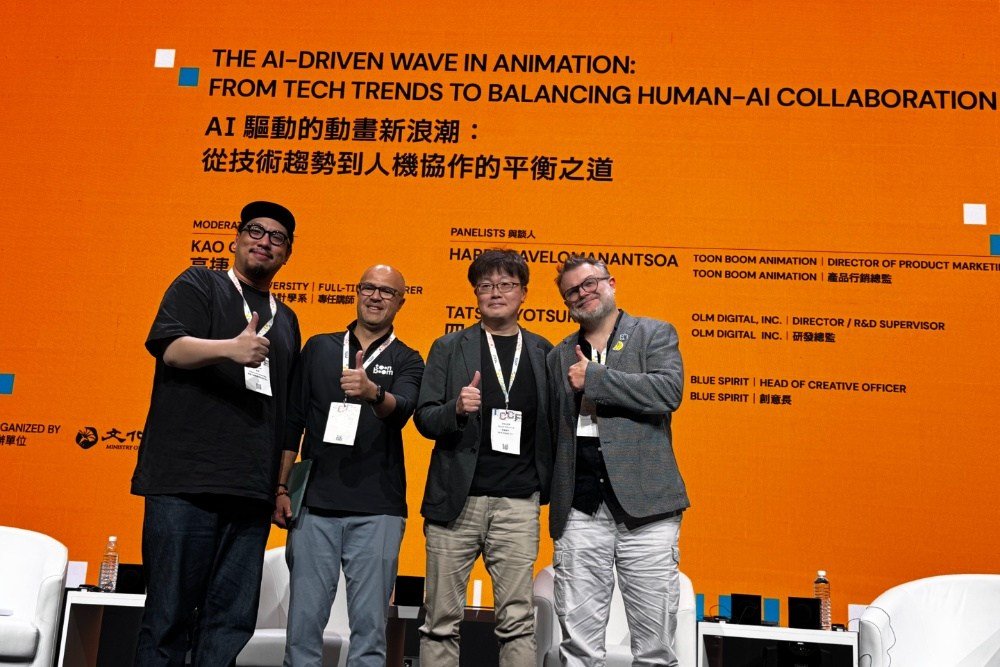
OLM’s AI coloring tool can absorb the visual palette of an anime production from as few as three hand-painted reference frames, according to Yotsukura Tatsuo, a board director at OLM Digital. He described the system during a session at the Taiwan Creative Content Fest in Taipei. The Japanese animation group is best known for the “Pokemon” anime series and films.
The coloring tool was not a standalone experiment. It emerged from ANIMINS, a 15-month research effort that Yotsukura led under GENIAC, a generative AI program administered by Japan’s Ministry of Economy, Trade and Industry. ANIMINS was set up to examine how anime creators might incorporate AI into their work. The project concluded in February.
Why three frames matter

In conventional anime production, coloring is a labor-intensive stage that depends on consistency across large numbers of frames. OLM’s AI coloring tool approaches that problem by treating a tiny set of hand-painted images as a style reference. Three frames are enough for the system to pick up a show’s look, Yotsukura said. That detail places the tool’s reference requirement far below what a full episode or even a single scene would contain.
The source material for that claim is Yotsukura’s own presentation. He did not describe the size of the training dataset behind the model, the number of productions it has been tested on, or whether it has been used in released OLM titles. What is documented is the reference-frame figure and the setting in which he shared it.
A government-backed frame for anime AI

GENIAC, the program that hosted ANIMINS, sits under METI, the ministry responsible for Japan’s industrial policy. The ANIMINS project ran for 15 months and closed in February. Its stated focus was how anime creators could put AI to use, and the coloring tool is the concrete result Yotsukura presented.
The structure matters because it identifies who backed the research and under what mandate. ANIMINS was a time-limited study, not an open-ended product launch. Its conclusion in February marks the end of the research phase as described in the presentation.
What OLM brought to the project
OLM’s credentials give the research a production context. The studio’s “Pokemon” work spans both television series and films, making it one of the more recognizable names in Japanese animation. OLM Digital is the group’s digital arm, and Yotsukura serves on its board. His role placed him in a position to lead a project examining AI’s place in anime workflows.
The TCCF appearance in Taipei provided the venue for disclosing the tool’s capabilities. The festival setting also connected the research to an international audience of content professionals rather than a purely domestic industry gathering.
Questions the presentation left open
Several practical details were not addressed. The presentation did not state how quickly the tool produces colored frames, how its output compares with human colorists, or what quality controls accompany its use. It also did not specify whether the three-frame reference method applies across different art styles or only to productions resembling the samples used in testing.
Those omissions are notable because coloring sits close to the final look of an anime. A tool that learns from three frames raises immediate questions about consistency across episodes, handling of lighting changes, and the division of labor between artists and software. None of those points were resolved in the account Yotsukura gave.
The research context
ANIMINS belongs to a broader wave of generative AI experimentation backed by Japanese public programs. GENIAC’s involvement signals official interest in testing how the technology performs inside creative industries. For anime, the coloring stage is one of several where automation has been explored, though the specific claim of learning from three frames is the distinctive element in this project.
The 15-month timeline and February conclusion mean the research phase is complete. Whether OLM’s AI coloring tool moves from research into production pipelines remains unstated. What is clear is that the studio has demonstrated a method for extracting a show’s color identity from a very small set of hand-painted examples, and that the work was conducted with government backing under a defined program.